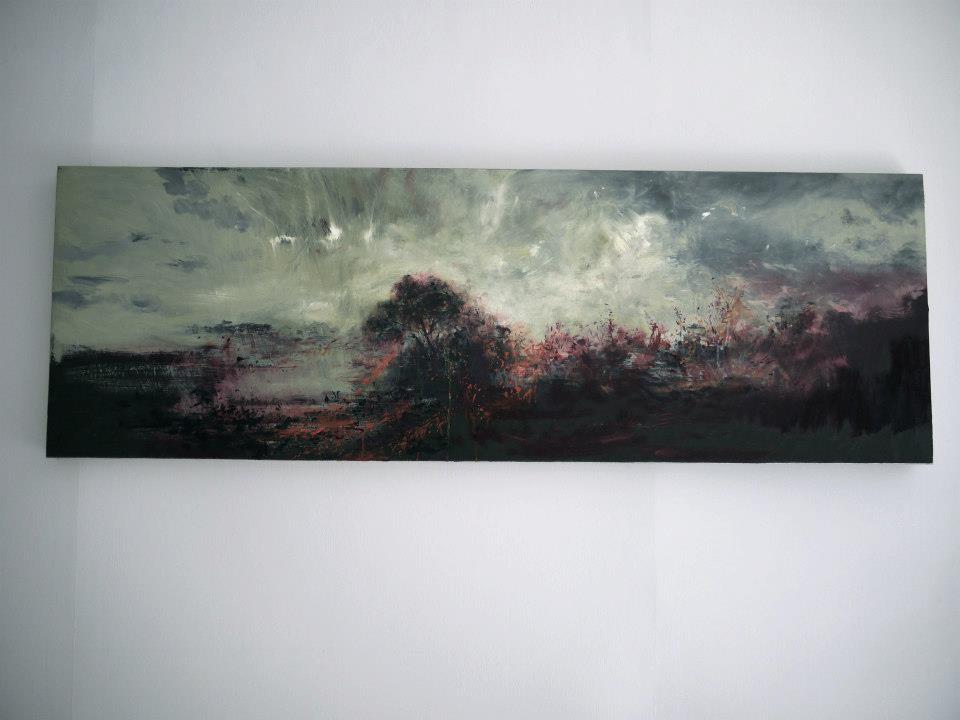
Thursday, April 3, 2014

WATCHING THE SEEDS GROW


The Mustard Seed
New works by Marcel Antonio
April 3-6, 2014
The Gallery, Greenbelt 5
Ayala Center, Makati City


1. Road to An Anti-Impersonal Symbology


MARCEL Antonio’s scenes have been viewed as narrative. By some—including yours truly—, they’ve been approached as quasi- and pseudo-narrative, more concerned with a certain enigma I’ve recently described as a sort of “blue funk erotica”. I described this “blue funk erotica” value here and here.
     In the present collection, however, I am eager to acquiesce to others’ semiotics and confess that a more pronounced symbolism in the artist has indeed come to the forefront. But, doubtful of this, as I am doubtful of any critical certainty upon artistic intent, I stepped on a doorstep critics have been told to be wary of, and that is the doorstep of talking to the artist about his real intent of the moment. I disobeyed the warning and knocked on the door.
     But I wasn’t keen on asking the artist about my readings’ correctness, only about his painting process. After all, artists do discourse on their process in exhibition catalogues and manifesto/thesis announcements during interviews. And, in certain snobbish quarters, artists are deemed significant or otherwise by a process particular to them or a group of them. Beatriz Milhazes’ imagery wouldn’t really be deemed special if she didn’t have that value of a different process added to the production of her imagery, would it? Argue with me if you like, but it has always been process that defined the being of every significant movement in the painting art. Action painting was but the bawdlerization of process itself, and jazz underscored improvisation as the immediate process occurring inside the structured product of a process of planning.
     And so my conversation with Marcel Antonio might give us a clearer picture of a thesis that has been so often waylaid by traditional critical self-centeredness, that is, by the critic’s intent to frame his reading as an exhibition by itself almost independent of the “presumed dead” artist. That tradition is no more pronounced than in the Philippines, where artists are seldom wont (or allowed) to announce themselves as thesis authors on their exhibitions’ catalogues.
     But, again, I did not knock on the artist’s door to ask him about his art thesis but to ask him about his process which should be his thesis, or at least should/could be a factor in a comprehensive appreciation of any critical thesis on the artist’s thesis (really the artist’s thesis as imagined by the critic’s thesis).
     And this, over coffee, was what I and the artist came up with:

ANTONIO’S symbology (whether quasi- or pseudo- or closed-text-) is not really “blueprinted” from the start. Like a good painting, it starts as a traffic of pencil or charcoal or pastel marks directly applied as ghostly presences to a trigonometry on canvas. We have a formal composition involving figures in arranged spaces. The figures in turn acquire gestures, facial expressions, glances towards positions in the compass, poses, and so on, bent on acquiring a sort of dramatic dance that has yet no meaning. The figures’ hands and glances and poses become pointing arrows that provide pictorial motion. Yes, exactly—the concern is initially formal, with the eyes of a character placed at, say, 8 o’clock directed towards 2 o’clock, a figure at 3 o’clock pointing a finger to an object at 7 o’clock.
     However, now, that’s simplifying the initial process too much, because simultaneous (not necessarily working together yet) to this formal beginning is the play with free association (which may later have an impact on the titling stage). Antonio may appropriate a dictionary of dreams or an online random sentence generator or the Inspiro app (an idea generator) on his iPad, all for the purpose of inspiring a drama springboard. A working title might be as kinky as “KC Concepcion tips the avocado hat of Slavoj Zizek” or as lewd as “A nun tilts a monk’s garden towards suburbia and Hollywood”. At this point, you may call him a Surrealist. Who isn’t nowadays, anyway?
     But all this playing around with signifiers to arrive at significance within a formal arrangement might impress some as too plastic if one didn’t know the fact that some artists who work in this way are really already planning their work during the process, if only by way of tapping their subconscious’ prejudices for and against “things”. The play is as necessary as art qua an affirmation of life. In this sense, it is in the negation of play that one becomes purely plastic. And in Antonio’s case of playing around with the contents of life, there is the artist’s definitely far-from-plastic bias towards “the enigma stereotype” and bias against the “happy” moment. In this sense, the artist does display a taste, mostly subconscious, invoking his right to a marriage with the moods depicting ennui, melancholia, de Chirico, Chagall, and so on. “Ayoko lang talaga ng smiling face (I'm just not fond of smiling faces),” says the artist, flashing a smirk. You can’t be more organic than that.
     This process, or process of processes, would then work onwards and work together until it finally gets things to gel. Gel, that is, color-wise, mood drama-wise, perhaps semantically, but primarily towards the fulfilment of a visual logic that had worked through its highways of visual premises and visual conclusions, with its visual conclusive finding finally sparked by the luminescence of the four or so layers of paint that now function as a glamorous glazed image.
     But I’m lying. For, at this arrival, there is the equally primary recognition of a power in the center, a drama at the center (not necessarily in the physical middle), that has decided on the peripherality of the peripheral and the graveness of the central gravity.
     Add to this feeling of fulfilment lies the bonus of recognizing the enigma of the recurring motif in relation to the other pieces in the studio. The power of the center has occurred in each piece and in the solar system of pieces around and in the galaxy of works that the artist had churned out through the decades retained in his memory. The beauty of the recurring motif has also arrived.
     And so we come to the titling stage, as if that wasn’t already working with the daily progress of the work, as it is the case often with artists working in this manner. Books read are recognized, movies seen are presences acknowledged, news events come into play, the working title bolstered or felled. The title comes not as a conclusion to a contrived process for closing an oeuvre but as a signature on a plate that has been acknowledged to be personal. Anything less than or beyond the personal is not yet done, the arrival must arrive at the personal. This is the satisfaction that comes with the recognition of the old familiar recurring motif, which we critics often desire to call the thesis element. The recurring motif becomes proof of the personal.
     It is now, at this point, that we can say Antonio’s symbolism has happened, in the past as open ones in acknowledgment of the values others may attach to the same picture, in the present as both secretly personal and publicly public by virtue of the publicly-shared referents of the chosen titles. The title itself has become a center.
     Then again, it’s not as if the title wasn’t already there progressing with the daily evolution of the work as it was initiated by the traffic of pencil or charcoal or pastel marks directly applied as ghostly presences to the trigonometry on canvas. So much for this talk about process. [FIN]


2. Depot of Anti-Expressionist Symbolism


SOME Antonio followers might have seen that 2012 Antonio work titled Poetry in Three Tongues. I call back this work to show how in the current show of mainly 2013 works it may represent Antonio’s transformation from an artist of a previous Blue Funk Erotica to being one for a new BFE direction. In years previous, Antonio’s BFE rested luxuriantly behind his quasi-narrative and pseudo-narrative still stage plays as well as in his illustration of various existing literary narratives that turned out to be more like BFE variations on the original stories they purported to depict.

monochrome photo of Antonio's Poetry in Three Tongues, 42 x 54", acrylic on canvas, 2012. From http://www.surrealismnow.com/totem/featuredartistpage.html

     That 2012-13 transformation leads us to the present collection of works, painted through the stretch of 2013, that momentarily (or permanently) leaves the poststructuralist openness of the artist’s older paintings to almost hype up that part in Antonio with a more closed text (as against open text) symbolist intents.
     Where is this symbolism leading us toward? In that 2012 work Poetry in Three Tongues, Antonio provided us a hint—familiar images of concerns mundane (chess play), deep (zoology study), and routine-economic (butchery work). As usual, Antonio’s portrait faces here defied expression (and expressionism) and played up his wont for that drama of thinking that in turn inspires viewers to inhabit a similar world of contemplation.
     What is the point of this contemplation? What should be the object of our contemplation? Another 2012 piece I would like to go back to is Aegri Somnia, which was a more literal erotica showing an undressing female’s back and backside (talk of facelessness as dis-expression that also hurled at our faces an ass!). Around this erotic central figure were: a clown/jester/harlequin on his way out carrying on his right shoulder a young female with a likely-false sceptre and crown in her hands (she had a mesmerized/drunken look, unworthy of a queen, directed at “the cameraman”, and Antonio avoided showing teeth in her open mouth); a student or intellectual sleeping beside his open book or journal; a gourmand studying a slice of meat on his fork; a young female figure observing a butterfly. If you had seen this piece, you would have noticed that action and expression, respectively, were present only on the bird diving toward a river and on a cannibal pig showing his teeth upon a roasted mate. This work’s drama was an ennui- or tiredness-filled world for humans, horror of horrors, where dramatic expressionism was the mere luxury of animals. And although anyone could have structured Marxist readings of a worker-capitalist or subject-royalty or powerless-powerful relationship into an Antonio scene like Aegri Somnia, in the end they would find themselves in a mere depiction of a quiet or hidden misery behind a contentedness both political and psychological. (If it’s an aesthetic contentedness, it then offers political and psychological symbolism independent of expressionism’s shock methodology).
     The psychology around this relationship gets clarified in some of the works in the present collection. In The Do-Nothing King, the royalty-subject relationship is more explicitly used to show a squawking, supposedly bird-brained bird-king (expression allowed on a roi fainéant!). And although the singer-figure on the left is showing his teeth as he sings and could be read as Antonio’s version of Munch’s The Scream, context frustrates (mocks?) expressionism as that figure’s singing ultimately ends up on the senses as nothing more than a picture of submission to a job’s requirement. Here is Antonio’s symbolist genius working through a Lee Strasberg device, quietly method-acting through space without the need to screech.

EXPRESSIONISM was inspired by 19th-century symbolism and carried forward even into this period of the 21st century the latter’s torch. But Antonio’s reservation towards expressionist symbolism is not in any way similar to Stuckists’ claims to “authenticity” versus Conceptualism.
     For instance, in what would otherwise be a Buddhist-cum-Christian narrative piece, the show’s eponymously-titled The Mustard Seed, we are presented a moustachioed man in a suit and tie carrying an axe, one leg embraced (hindered) by a dwarf, as he approaches the supposedly mustard tree. Lesbians kiss in the background, another male figure on the right eats indifferent to what’s around him, and two blank-faced females appear on the foreground. It’s all a product of an attitude that seeks not to destroy an expressionist bent but merely to offer an alternative—the alternative of disengagement. This modesty, compared to expressionist self-hype of its direct engagement, is his own modest mustard seed to achieving an aesthetic heaven.

The Mustard Seed, 60 x 60", oil on canvas, 2013

     If there’s any mockery in this show at all, it’s in the subtle mockery of expressionism’s tantrums. As an option to these tantrums, Antonio offers symbolism’s postmodern self-consciousness or self-semiotics. I was already seeing it in 2012, as in an acrylic titled The Mirror Stage, where Antonio portrayed a Lacanian self-remembering. In the picture, a boy pondered himself on a girl’s looking-glass while the girl lying on the ground contemplated her imaginary self while looking at “the painter’s camera”. Defying the concept of self-contemplation as synonymous to narcissism (you could see a pool of fishes in the background)—perhaps narcissism has more in common with tantrums and complaining—, Antonio demonstrated that postmodern self-consciousness is self-alienating instead of self-identifying, actually a denial of identification even as it struggles with the truth of the surrounding illusions. Or is this denial of identification verily a resultant of this very struggle with the truth of those surrounding illusions? Ultimately, after the fact, all those (de Chirico-esque) objects in Antonio’s compositions act as mirrors for his characters’ self-conscious crises.
     In a piece in the present show titled A Love Encounter, the lovers’ dance and the accoutrements of courting likewise become mirrors for this self-alienation. Animals are mirrors for contemplating the relationship between self and those living others, going beyond anthropocentrism. Mulling over one’s nudity becomes a meditation on one’s place in the existing interrelationships in nature, on one’s humanity within the ecology. But lest we equate this self-consciousness solely with intellectual reflection (zoology, perhaps), it can also lead to the denial of the self through escaping intellection and falling for the (albeit boring) freedom of socializing (card games, perhaps, or hobbies like sewing).
     And so, coming full circle, we come to understand Antonio’s obsession with ennui in the years past. It is not simply “boredom” the way the word would translate to English, but the product of man’s estranged relationship with a challenging world. It is in fact an almost-sad surrender to the mysterious Immensity. But while some would illustrate alienation with the self-deprecating smile of humour or self-effacement, Antonio illustrates it with features of reflection (science, magic), contrivance (religion, myth-making, story-making), indifference (the ennui we see), and subtle or silent (because fearsome of aloneness) detestation. We see that last struggle in Myths to Live By, through the psychology of a dancing couple in the foreground who may not really be into their being a couple—is marriage one of the social myths Antonio would want to include in his Joseph Campbellian list of myths? We don’t know.
     In To Be or Not to Be, Antonio combines elements of cubism, the collage, and Pop art to posit his characters in a psychology of awe, speechlessness, and innocence/ignorance vis a vis a colourful world of consumer goods and decisions. The human perspective here becomes no more intelligent than a dog’s.
     Other possible relationships (between man and objects as well as between man and others) are explored further in a Kafkaesque composition titled The Test. Antonio’s acting direction works well here in representing the tension between two debating male friends, again subtly presented instead of loudly.
     Another subtle trick is used for Untitled, where a post-coital scene of two young people sleeping as curling shapes on a beach is foregrounded by the sea’s curves, a curling fish set within. Is the fish asleep (in harmony with the couple) or not (contrasting with the couple)?
     A masterstroke of subtle symbology is Life Is A Struggle Against Sleep, where Antonio’s bored actors struggling to kill time with their respective chosen interests—as mere workers for or subjects to a giant hand of power—are backgrounded by a de Chirico window to a metaphysical world, transporting thus the ennui and acquiescence to other possible philosophical or even political heights.

Life Is A Struggle Against Sleep, 42 x 54", 2013

     The Devil’s Backside (a word-play, perhaps, around the title of the del Toro horror flick The Devil’s Backbone) tames the terror in the devil and night owl figures through a post-coital-ennui composition that’s been a signature Antonio mannerism. Notice also the artist’s nice habit of inhabiting many of his scenes with “workers,” in this case a brass-band musician.
     More workers inhabit The Midnight Radio Hour, just as they do many of the pieces in this show. But in Midnight Radio Hour, the scene occurs in the bright of day, with the modern-day urban inhabitants going about their business (is Antonio mocking or emulating grade school social studies textbook illustrations?), expressionless, with one asleep. Thus, even Diego Rivera’s Marxist expressionism gets a kicking in this river of Antonio dramas.
     The drama of roles is played on further in The River Dreams of Angel Flores, Jr., where we see the living head of the late Angel Flores, Jr. (aka Roberto Chabet) floating on a dark river, his body left on a wheelchair at the bank. You could say this is Antonio’s salute to last year’s passing of his dear professor and godfather, acknowledging the aesthetic guru’s eternal presence in the Philippine art world’s river of artmaking dreams; but doesn’t Antonio also here regard the river as separate from his worldly concerns? And so Chabet’s open-eyed intellectual leaning towards the abstract and the conceptual is thrown into this collectively-emulated river, as if to say, “look at me, sir; see me go back to the symbolist narratives and myths that you so left out in your (equally mythological, by the way) ocean of preferences.”
     Indeed, Antonio’s symbology does try to cover all the grounds of his personal semiotics, from where he works like a free jazz artist who starts from A, goes on to B and C and D and so on, and later goes back to A. This is what decides for Antonio’s process of adding or replacing images to a composition. For instance, in Antonio’s 2012 work Elective Affinities (not in this show), the artist’s philosophical bent started as a visual pun on the egg in Magritte’s own Elective Affinities, which latter piece was itself a pun around the title of a Goethe novel on chemical affinity. In Antonio’s version, the egg was a bright female thigh near the groin; the Goethean chemical incompatibility, meanwhile, was dramatized by the painting’s male figure’s seeming rapture directed not at the female figure but at another object of interest: a book. The Goethe theme went to Magritte went to Antonio went to Goethe. Or was this Antonio’s self-critique on possible incompatibilities within his own symbolist erotica occurring in that surrealist space between his symbolist intent and his audience’s reading?
     In his new works, as in Two Girls Reading a Book, Antonio’s self-critique on possible incompatibilities within his own symbolist erotica is illustrated by the distances occurring between objects of intellection (e.g. books) and the knowledge pursuer, between knowledge pursuer and the disinterested, between what could be knowledge and what could be pop rumor, as if that last portrays symbol reading itself. Indeed, in 2013-14, two girls (or boys) reading a book, or reading a painting on a wall for that matter, has entered the gallery of the mind way beyond where Picasso’s work with the same title could go when it attacked our eyes in 1934.
     The Mystery of the Butterfly Wing, meanwhile, compartmentalizes individuals into profiles with props. That makes that title quite apt, considering that in science that would precisely translate to “the mystery of diversity”.
     Then, Antonio takes this compartmentalization farther in Untitled (with big fish), where the partitions are more psychological than spatial. The cubist-collage format as dream generates a social take on urban alienation.

Untitled (with big fish), 43 x 54", acrylic on canvas?, 2013

     Finally, in Pandora, the psychological partitions turn into portrait images of self-immersion, this despite the image in the background of a relational activity (a relational activity which could in itself be a product of a self’s or the involved selves’ selfishness). Self-immersion as self-worship? We know better, of course; judging from all the Antonios we have seen through the years, any self-immersion is really an immersion in the distance between the self and something or someone else. Self-immersion as the root of all evil? Perhaps.
     Indeed, with this collection’s dizzying array of intelligent significances, it is already a cause for celebration that in spite of the commercial popularity of the many sorts of Marcel Antonios peddled to the art market these past two-plus decades, a popularity enough to content an artist towards luxuriating in the routine of mass producing his success, the Antonio thesis has proved once again that it will never ever be dead in its tracks. Year after year the BFE thesis develops. Well, perhaps it has really only just begun. [FIN]


Marcel Antonio’s new dive into symbolism


http://lifestyle.inquirer.net/155715/marcel-antonios-new-dive-into-symbolism-2


Wednesday, May 29, 2013

ANG HULING HALAKHAK


Photos of Jessica Soho and Vice Ganda from Vice Ganda-Jessica Soho Issue Recalled, Ogie Diaz Reacts | PhilNews 


--------------------------------------------------------


“Some men, under the notion of weeding out prejudice, eradicate virtue, honesty and religion.” 
― Jonathan Swift


UNA sa lahat, ganito.
     Joke: "Ang hirap nga kung si Jessica Soho magbobold. Kailangan gang rape lagi."


     Apologia about joke: "Hindi ko po kailanman gugustuhing kutyain ang sinumang rape victim. Wala po akong intensyong masama, na gustuhing pagtawanan ang mga rape victims, alam ko pong seryoso ang rape. Kaya hindi ko po ginawang seryoso na pagtawanan ang rape victims. (?) Wala po akong intensyong masama. . . . pinalaki nang pinalaki nang pinalaki na ginawang isang national issue na nagsimula sa isang simpleng biro. . . . Kung hindi po ako nauunawaan, paumanhin po ako sa inyo. Sa mga nakaunawa nang mahusay sa mga biro ko, maraming-maraming salamat. . . . Hindi lahat ng jokes ay nakakatawa; depende yan sa kung paano mo tatanggapin."


HAYAAN niyo akong palakihin pa ng kaunti ang isyu. Tulad ng iba riyan, mahilig din akong magpalaki ng isyu, dahil pinalaki ako ng mga nag-alaga sa akin na ituring na malaki -- at maaaring palakihin pa -- ang lahat ng bagay, ang lahat ng detalye, ang lahat ng isyu sa mundo, kung kaya't kahit ang pulitika sa likod ng simpleng imported na arina na ginagamit sa ating inosenteng pambansang almusal ay pinakikialaman ko.
     Totoong maraming biro ang hindi sinasadya. Maraming biro ang may tanging hangarin na magpatawa lamang. Simpleng biro kung tawagin.
     Subalit ito ang itatanong ko. Gagawa ka ba ng jokes tungkol sa mga Palestino sa harap ng mga Palestino, o jokes tungkol sa korapsyon sa Vatican sa harap ng mga Obispo? Tunay na matatawa ang mga Nazis sa mga jokes mo tungkol sa mga Hudyo. Totoong matatawa ang mga macho sa mga jokes mo tungkol sa mga bakla. At malaki ang tsansang matawa ang mga bobo sa mga jokes mo tungkol sa pamilya ni Aling Nena: pilay ang panganay, mataba ang bunso, payat ang asawang may tuberculosis.
     Hindi mo kailangan mag-isip para magpatawa. Sabi nga ng satirist na si Jonathan Swift, kailangan mo lang ang iyong prejudice. Ang career ni Swift ay madalas na umikot sa virtue at kasalanan ng prejudice na tila kasama na ng human-ness.
     Maraming mga biro ng prejudice ang naririnig natin araw-araw galing sa mga tambay, o di kaya galing sa ating mga propesor: mga simpleng biro tungkol sa mga Bisaya, sa mga Kapampangan, sa mga Intsik, sa mga Bombay, sa mga pilay, sa mga bakla, sa mga relihiyoso, sa mga walang trabaho, sa mga Pilipino, atbp.
     Maraming biro ang maririnig galing sa mga matatanda, mga kabataan, galing sa mga relihiyoso, galing sa mga gago, galing sa mga matutuwid, galing sa mga bakla sa salon, galing sa mga barako sa beerhouse, galing sa mga kriminal, at galing sa mga santo, at ang lahat ng mga simpleng birong ito ay ayon sa kanilang prejudices.
     Uulitin ko lang po ang Swiftian axiom: ang nakakatawa at tawanan ay produkto ng ating prejudice.
     At dahil ang bawat komedya ay galing sa isang prejudice, malamang na isang araw ay may aalma sa mga biro mo kung ito'y narinig ng target ng iyong prejudice.


HINDI ko minumungkahi na maging mas "malawak" o "sensitibo" pa ang ating mga komedyante, dahil hindi ko rin lubos maisip kung paano mangyayari iyon o paano gagawin ito. Inaalok ko lamang na sila'y maging mas mapagmatyag sa kanilang manonood. Ito ang sasabihin ko sa kanila:
     Huwag gagawa ng biro tungkol sa mga Hudyo kung ika'y nasa Tel Aviv. Huwag magbibiro tungkol sa mga Bisaya kung ika'y nasa Cebu. Huwag magbiro tungkol sa mga walang edukasyon kung ika'y nasa basketball court ng squatter area sa Tondo. Huwag magbiro tungkol sa gang rape kung ika'y nasa ospital na may mga biktima ng gang rape. Huwag magbiro tungkol sa obesity sa Christimas Party ng . . . may obesity problems.
     Kung nasa Araneta Center ka naman, maging mas mapagmatyag! Dahil hindi ka nasa Christmas Party ng mga German neo-Nazis na okey ang mga jokes mo laban sa mga imigrante sa Germany, hindi ka nasa Christmas Party ng mga Obispo na okey ang mga jokes mo laban kay Risa Hontiveros. Nasa party ka na kung saan maraming uri ng tao ang nanonood!
     Inaalok ko ito hindi dahil malambot ang puso ko sa lahat ng uri ng tao. Tulad ng lahat ng komedyante, may mga prejudices din ako.
     Inaalok ko ito dahil malambot ang puso ko mismo sa mga komedyante, dahil komedyante rin po ako -- mahilig akong magpatawa at gumawa ng jokes laban sa mga kinabubuwisetan kong tao at hayop.
     Ang mga may prejudice laban sa mga kinaiinisan ko ang tanging nakakaintindi sa jokes ko. Ang mga kinaiinisan ko, o yung mga nag-aakalang naiinis ako sa kanila dahil sa jokes ko, ay natural na di "nakakaintindi."
     Naiintindihan ko ang trabaho ng mga nagpapatawa. Ang magpasaya.
     Marami nga naman tayong kinaiinisan sa mundo, madalas nga ay hindi natin alam na kinaiinisan natin sila. Lumalabas na lang iyan sa mga jokes at pasaring natin. Ang hangad lamang natin ay mapasaya ang mga Komunista sa kanilang mga kampo, halimbawa, o ang mga Protestante sa kanilang mga simabahan, o ang mga Ilokano sa kanilang rehiyon, o ang mga robber-rapists sa kanilang mga hideouts. Depende na lang yan sa kung sino ang kliyente natin sa ating propesyong pagpapatawa na tatanggap sa mga jokes natin.
     Ngunit naiintindihan ko rin ang trabaho ng mga galit. Ang magalit.
     Kaya ito lang, bilang panghuli. Inaalok kong huwag na huwag nating pagtatawanan ang mga galit na. Sinasabi ko ito hindi para takutin ang mga sarili natin sa sindak ng kanilang galit, kundi sa takot lamang na baka, sa bandang huli, hindi maging sa atin pa rin kundi sa kanila na ang huling halakhak. ###


“The latter part of a wise person's life is occupied with curing the follies, prejudices and false opinions they contracted earlier.”
― Jonathan Swift


-----------------------------------------------------------


ADDENDUM:

May 31, 2013. Tinawag ang pansin natin sa isang segment ng sitcom na 
Bubble Gang, na ipinalabas noong taong 2010. Heto iyon: CLICK DITO.


June 6, 2013. Nagpahayag ng kanilang galit o pagkadismaya ang ilang mga taga-St. Scholastica's College dahil sa isang Pugad Baboy comic strip na may slur laban sa lesbians sa all-girls Catholic schools: CLICK DITO.

August 19, 2014. Idineklarang persona non grata si komedyanteng Ramon Bautista sa Davao City matapos mabastos ang city government officials sa isang patawa nitoCLICK DITO.


Thursday, March 7, 2013

A Social Liberal's Disclaimer on State Art Subsidy


(this 1,183-word mini-essay is adapted from one that I posted on my official website in the year 2001; the last four paragraphs that I added to that essay here derives from a conversation I had with Manila painter and gallery owner Simkin de Pio and veteran journalist and columnist Sylvia Mayuga this morning)


IN SEVERAL blogs of mine (such as here, here, and these seven blog essays with the label "art and the state"), I mainly carried my earlier belief that art should not be the business of government that shall have to use tax money for art's promotion. I went against the hidden rationales for such institutions as the Cultural Center of the Philippines, the National Commission for Culture and the Arts, and the concept of a National Artist of the Philippines title award. My main argument was that these all subsidize a lie, and promote a reflection of an art not of the people these pretended to be for but merely of an elite set of artists and art aficionados serving the aesthetics of the elite.
     Another aspect of those blogs implied a truism, such as that in literature concerning the politics of publication. Within a clique-prone Philippine literati that leaves no room for a totally dissenting standard of younger literary aesthetics, for example, the young---ordinarily counted as part of the nation---may either be marginalized or forced to conform.
     However, I now happen to have a different macro-view of both these matters, despite my retaining certain facets of my old angle.
     My change of view on the first matter is not borne of any interest in an endowment or grant from such an institution as the NCCA, the CCP, a state university, or a government entity; nor has it been prompted by a meditation on the possibility of being offered any such help which may come, say, in the form of a publishing grant.
     This change has simply been promoted by a realization. I've realized that perhaps my initial reaction was due to a complex combination in me of 1) an arguable populism and 2) a simple disgust at the overt patronage system I saw around me that seemed to advocate adherence to established aesthetics. The change came thus: a later self-assessment of my point of view led me to realize that government cannot avoid engaging itself in the promotion of what it deems to be the nation's art, or what it idealizes to be the nation's art, as what ought to be its art. It cannot.
     My realization said to me: perhaps our individual protestations are more towards details of a ruling clique's actions, actions which would involve sins of omission or sins of wrong inclusion, and so on. For in the end one might not protest too much if one's interest, selfish or partisan, is drafted into this same system. For, certainly, all regimes cannot ignore the authority of controlling a nation's art collection and subsidies in the same way that it cannot ignore the necessity of holding on to a Department of Education and its consultants.


FOR WHAT would happen indeed if we leave everything to the people (or a corporate elite)? Especially among a people rendered helpless in clamoring for a more socialized education, albeit from a government which has its hands tied to the interests of creditors?
     All governments must and do involve a modicum of elitism, if only---at best---to guard the populist philosophy of serving the people. This, because the people, one might say, and this is a lesson even the Communists have learned throughout their insurgency, are not always likely to have the capacity to know what's good for them (or even know who's truly on their side). Businessmen who practice the daily art of hype know very well that people will try to learn what any hype advises them to know, and it is only government that can apply the virtue of turning its elitist influence into a pro-people program, as against corporate patronage the motives of which may either be solely profit, coursed through subtle cultural propaganda, or tax rebates.
     There will remain conflicts over a government's sponsorship of certain art, mainly on what should be up there and what shouldn't, who receives aid and who don't, and changes do occur through the dynamics of history. But no one can argue against the fact---I believe now---that all governments have a need for symbols and monuments, whether solidly manifest or invisible/intangible, and the art each regime promotes, bad or otherwise, mediocre or great, shall be a reflection of its (sometimes fraudulent) populist vision.


MY ONLY wish is that every regime's espoused art fully acknowledges and declares itself as part of the regime's art intended for the nation. The state ought to require this acknowledgement and/or declaration, as government ought to be fully aware of what its appointed cultural and arts people are doing in the cultural and arts departments, with the same concentration it is putting on the education front. The cultural and arts departments of the state are, after all---whether the state admits it or not---, part of the state's propaganda machine for advancing its ideology (and aesthetic ideology, if any).
     Conversely, critics must likewise accept the fact that there is always that direct correlation between the state-supported art products displayed and endorsed/awarded during an era and that era's regime's ideology (and aesthetic ideology) or lack thereof. Noting this, therefore, the context of a social realist's receiving an award during an oppressive neoliberal era would be entirely different from the context of the same occurrence during a socialist or social liberal government's era. With critics aware of this relationship, whining is put aside and mere recording of the contexts becomes the only necessary order of the day.
     In a Business World article circulating in Facebook this morning regarding a supposed golden age in Philippine art, the issue about a necessary government support for art was likewise discussed. In the article, art critic and curator Patrick Flores was quoted as saying, "The legacy of art is to instill imagination. The government is not investing in art as a product, but (it is) investing in imagination. A population with imagination becomes more critical, not sunud-sunuran lang (not just mindlessly obedient). They are suspicious of convention, of norms. Art goes against norms. Of course this will not be immediate, but it can shape the world."
     Patrick is of course wishing upon the state. My view is that we can't really whine against the state's intense or otherwise lackadaisical role in/with the arts, because the state will always do what it pleases as regards the cultural and arts departments under its wing, according to its ideology or lack thereof. Again, the role of the critic is to record this correlation between the state and its art programs (or lack thereof), not impose on it or protest against it (which imposition or protestation only amounts to whining from a lack of understanding of the regime's own philosophy or aesthetics). Thus, we cannot whine against a Gloria Arroyo - Carlo Caparas correlation, for instance, as what happened in Arroyo's last year in office. It is, instead, the critic's better option to record that correlation as apt to an Arroyo ideology. You can't criticize the correlation, for the simple reason that it's a correlation. You can't criticize data, simply because data is data. You can, however, criticize the ideology that produces that correlation. [END]


Tuesday, February 26, 2013

A NATION’S 20/20 IMAGINATION


“Real politics is to engage to resolve problems within a collective with enthusiasm. It's not simply to delegate problems to the professionals. Love is like politics in that it's not a professional affair. There are no professionals in love, and none in real politics.” – Alain Badiou


“The President’s Office” (curated by Antares Bartolome[1]) occurred at the U.P. Vargas Museum from January 8 until February 9 this year. It was purportedly part of “Blind Spots,” a working series exploring restricted spaces as springboards “for imaginative construction.” So, presented with that goal, how did one—like a poet—show off anticipated wit upon neither images of seen reality nor the concocted images of surreal dreaming but upon merely hidden but ostensibly real spaces? How did the imagination work around this latency?
    But the deeper question would be: what was the resultant of such an exercise? With which did the imagination try to work? Detached humor? A more direct caustic humor? Emotional sarcasm/satire? Empathy? Sympathy? Understanding? Paranoia? Ignorance? Indifference? What? The artist could in fact have explored all these points of flight with all the usual creative aplomb or fun were he using more universal imagery, as, say, a child in a garage unseen by its mom trying to back up the car. Exploiting such an emotional scene-situation for artistic concerns and causes is commonplace, especially in the cinematic art of pounding our universalized, normal hearts.
    It’s a different story when art becomes political. The imagination may be allowed all sorts of humor and colors of expression (the too-dark, the too-red, the green with envy, the yellowed, even the too-heavenly-white), but simply cannot suffer to be seen as shallow in its working with ignorance. This, especially in a country currently under someone at the helm who has been counter-critiquing his “matatalinong” (read: ignorant) critics, labeling them as mere workers in a burgeoning criticism industry, working, that is, to keep the network or readership ratings up or keeping opposition party elements in the sound bites roster. In short, here is a president flaunting the substance of achievement while quasi-exposing what he likes to call journalism’s possibly-corrupted refusal to see the good. And, indeed, could the “fourth estate” proposal be a myth in our corrupted or partisan times?
    In this show’s case of handling a political motif, however, values other than a literal criticality’s were placed on the table. Despite the mind-influence of the more overtly political exhibition in the museum gallery’s adjoining wing (which mused on the question of land use from progressivist art’s standpoint), or despite the show’s wall notes claiming a portrayal of a “den of thieves,” in the end “The President’s Office” put forward less the emotion or intellections of politics than the luxury of the imagination, in the end clarified what installation art qua craft and art is all about. The individual concepts may indeed have been familiar, may have been established before by jokes from the drinking-binge table or the radio station booth or the sitcom set, materializing as our "expectations, fantasies, and perceived relationships that overlay our collective imaging of the seat of power." But the show’s PR-announced point—exploration rather than expression—unwittingly or wittingly succeeded as elegant executions of simple black jokes, expanding on the jokes by sheer subtlety of imagery rather than an insistent expressionist righteousness.


    For instance, with Soiree (Dahil sa Iyo), Alwin Reamillo’s offering of a possible Palace piano[2] (red, white and blue feet and the President’s seal on the body’s side for this symbol of opulence) took on the acerbic but common view of the Presidential office as one that’s often just playing our economy via the fiat of mere ear training. But departing from the clichés of radio broadcasters who may know little or nothing about fiscal policy, Reamillo donned the robe of the poet and looked for a rarer eloquence to deliver the same old message. Here, he literally filled the piano’s soundboard with a large amount of shredded bank notes (bought from a community of garbage pickers in Gloria Arroyo’s province after watching a TV report’s discovery of a Central Bank secret disposal in 2011). Then he glued a wooden heart’s-anatomy chart (“wooden” pun not intended?) to the center of the grand piano’s top, almost neutralizing the acerbic wit and projecting a serious note. Apart from the playing-with-our-money context’s referencing a central space in Malacañang called the Music Hall (often used for important meetings with selected members of the cabinet and for entertaining foreign dignitaries/diplomats), the glued-on heart’s and title’s alluding to Imelda Marcos’ favorite love song, “Dahil Sa Iyo,” the P20-P50 notes’ carrying the images of the Palace and Old Congress building, and the shreds’ simulation of a garbage dump or volcano (read: social volcano), the formal contrast between the piano’s lacquer gloss and the shredded bills’ matte truly affected glamour not only to the mind but also to the senses, taming thus the politics somewhat without erasing it. In the end, it was the elegance of the satire and our tempted senses’ reaction to the presentation apart from the sardonic statement itself that became the point. It didn’t matter now if the original criticism was correct.


    An elegant caustic humor, meanwhile, showed in the collaborative work The Stockholders by Mity de la Peña/Jed Nacabuan/Patch Qunito/J.P. Samson. This literal wall piece factured the common intelligentsia wisdom that says Philippine political maturity is rooted not in history but in cinema. Hastily painted portraits of past presidents and presidential wannabes carried titles of movies (local and Hollywood) and were placed at the tips of a painted tree’s roots. Meanwhile, right below this, Leo Abaya’s Rigodon played with the check-patterned floor tiles of the Palace and associated this with the chess game of politics by illustrating a (pseudo) chess problem using floor stickers of chess-piece shapes and photo-stickers of Philippine presidents’ faces as chess pieces (all pawns) on the fake tiles. The idea of the artist as whining mimic or mocker of a chess composer would here have to be mentally contrasted with the idea of that imagined composer who often laughingly wins.


    To address the issue of security amidst political conflict and ambition, Cian Dayrit provided readymades-of-sorts titled Trophy Pelts, involving cult-religious “bulletproof vests” placed in the gallery, thus evoking the late dictator’s (and his wife’s) predisposition to fall for such indigenous superstition as well as the present president’s adherence to ethnic Chinese-Filipino feng shui beliefs. The title may likewise refer to the belief in a throne/power as divine grace.


    But it was Manolo Sicat’s furniture set, Palamuti ng May Sala, that was able to produce a multilayered statement akin to Reamillo’s. Albeit gleaming in white, the coffeetable made of steel bars wrought into the word “Mabuhey” on its glassless top was unusable, as were the benches made from pieces of discarded wood, with their backs looking a lot like an architect’s model of slums. As foyer pieces that seemed to welcome Palace visitors to a reality beyond the whitewash, this was one of the show’s works that wore the loudest color of mockery.


    Looking outside the gallery’s glass walls from where the lobby white furniture pieces were, one could glean Buen Abrigo’s half-concealed puppet-looking armalite-toting figures with woven bags for head masks positioned on some trees, PP1017. While suggestive of Palace security sniper personnel, the woven-bags-for-masks called to mind the appearance of the local informants of the Japanese-invasion era called the “makapili”. Were these snipers supposed to be the same type of traitors, personnel deriving from a social class who have nonetheless chosen to serve lords of another social class, a ruling class?


    Another amusing piece was Lisa Ito’s Personal Domain, a wall map under glass emulating the appearance of official technical maps or military maps. However, this emulation led to surprise (or did it?) as it happened to be by a more personal presidential map where state nomenclature gave way to filial historiography. For instance, an island was named “Asyenda ni Lolo” while another was called “My Sanctuary.” Indeed, in Philippine politics elitism is a perfect equivalent of British royalism.
    Kristine Calayan’s Made to Measure featured portal columns made of raw piña fiber and rice paper, classy but vulnerable. Behind this, Mark Justiniani’s 2-in1 piece, Hole/Appointed, was outstanding. For Hole Justiniani appropriated a part of the gallery’s architecture for imagining Malacañang and the Presidential chair. While a stainless Damocles sword hung above the chair in Appointed, beside it on the white floor was a manhole-shaped glass-covered floor exit (for Hole). The hole revealed an aluminum ladder rung leading down to an unknown tunnel area, with rows of light bulbs illuminating the way. It was an elegant piece of work that was terse but sweet, with all the moods of sci-fi, spy cinema, and steampunk converging in the brain’s own creative appreciation.


    Then, coming out of a blackened wood gate (simulating precious mahogany) was the piece by Salvador Alonday, What stood there in the doorway, a sculpture of a large sea turtle with a human head (in concrete and acrylic?), possibly referencing folk parlance’s regard for the turtle-man as one who is slow and seldom comes out of his house. For a large king turtle-man to be let out of its house and beyond, out of its gate, is to hasten a political contextuality of what’s impossible, or of wishful thinking, or otherwise of a shocking fulfillment of what we think could never happen—the slow leader has come out of his comfort zone to face his nation.


    Now, what were a couple of paintings—two from Buen Calubayan’s Landscape Eternal series—doing in a show of installation art pieces, unless they were to be read as installation art pieces themselves? An erstwhile First Lady had the reputation of being a buyer and collector of expensive local paintings and priceless foreign ones, modernist as well as of previous periods, so: would she have bought these paintings of what looked like fallen bodies on a tree-surrounded rally ground and of a blood-spattered open field? Would any president’s wife or sister receive them? Should one, there’s a new paradigm.


    Noel EL Farol’s bookshelf was one compound of context pieces, with each piece its own lyric poem.


    One layer of thought would have perceived the shelf contents as mere representations of presidential books/references. Another angle would have considered expression in material execution:
Unfinished Business (Series A) and (Series B) were constructions of discarded wood, thus books never touched again, never to be touched again at all; Spratly Islands’ Souvenir was a glass case filled with white silica sand, a touristy memento of what is otherwise a motif of geopolitical urgency; Filipino Favorits was another glass case containing rice and a water vessel, another touristy treatment of an economic point of class conflict; Target Appointees was a dartboard signifying a not-so-good marksmanship; while Executive Appointments’ glass case containing toy guns could have been toying with the idea of a shooting sportsman-president’s image of having appointed shooting range mates. Noli by JP and Fili by JP were books of constructed steel, presumably locked in, never to be read again, or otherwise mere monuments to a now-faux nationalist cause. Ang Bagong Balita was a copy of the Holy Bible cast in resin, unusable thus. Filosofi, a collage on found objects, seemed to signify precisely that—political philosophy as a syncretist’s collection of found objects, like slogans that can change like window curtains. Consti was supposedly a printed copy of the Constitution, or so said the engraving . . . on constructed steel—thus, again, not needing to be opened for reference since it couldn’t be opened anyway. Sure, the obvious social and political polemics of each of the Farol sub-pieces may falter in an argument of facts, but that would miss the point. Again, the point is the alienation of subjects of a land from the truth and facts behind a Presidency, any Presidency. It occurred to the artist to come up with a concept anthologizing mini-concepts, a mini-show by itself inside this anthology show—coming up with that was already a point for applause.
    Applause. Mideo Cruz inserted that audio player into Farol’s shelf and played in a loop the applause of US Congressmen for Corazon Aquino’s presence in their halls in 1986. He titled the sound recording Booby Trap, to allude perhaps to the presidential promise to pay all debts incurred by Ferdinand Marcos. Was the US Congress applause the trap that Aquino couldn’t get out of later? Was the applause and US Congress visit merely the crowning ceremony for a trap set up even before Aquino’s US-supported campaign began? In which case, who was booby-trapped, Aquino or her subjects? Consider the fact, also, that the recorded applause did sound a lot like a rainstick flurry, an aural cheese to a rat trap that would hurt.


    Finally, there was Renan Ortiz’ Sugod, positing Malacañang security in a tweaked survival video game called Lusob (Attack/Invasion). Often in a video game one can choose to be either the protagonist or the antagonist. Was the gun-wielder in the played loop a security man or a coup invader, then? Were the men in barong Tagalog executives of the Palace or were they attackers disguised in barong? Were they armed enemies or were they civilians? Whatever (partisan) setting you would have chosen for your imagination to play around in, the reality remains that the Presidency of a State presupposes enemies and conflict. And corollary to that, the hidden fact remains that the President of a given territory and race could also either be that nation’s hero or its treasonous villain.
    Reamillo’s Presidential wall seal encased in glass—and made up of shredded bank notes for border accoutrement and crab shells for the seal ground—laid the contextual axiom for all:


    Stating the obvious statement of this piece, titled Sa gisa ng Pangulo, amounted to The President having gotten to his post via a lot of hidden moolah and by the strength of his crab mentality. But could it also be usable for a non-obvious signification?—alluding to achievement by a popularity shredding the influence of moolah and by an ability to unite and trample on the need for crabs in the bucket? Whichever type of President one is, this seal can remain as the seal.
    And whichever type of President the viewer may support, the pieces in this show could remain in memory to refer to either a forgotten past, a disappointing present, or a long insufferable future. For their part, professional artists will continue to reflect a blinded and divided nation’s 20/20 imagination while abetting, examining, or merely suffering its ramifications. For art’s sake, yes, but also for reflecting on the polis. After all, political art is not just a professional affair. [END]


  • [1] son of activists Heber Bartolome (the folk rock singer-songwriter) and Maita Gomez (the late beauty queen)
  • [2] Reamillo’s is not exactly a total outsider’s perspective. The artist’s affinity with pianos (he has used the image in a previous restoration project called Nicanor Abelardo Grand Piano Project) stems from his family's involvement in maintaining all the pianos in the presidential Palace. Though he hasn't been to Malacañang himself, he often recalls the white piano his family built specially for the Marcoses. Imelda Romualdez Marcos's piano tuner was an older first cousin, whose brother also worked for Imelda’s brother and later Tacloban mayor Alfredo “Bejo” Romualdez.

  • _____________________________________


    PHOTOS BORROWED FROM VARGAS MUSEUM'S WEBSITE AND FACEBOOK PAGE. OTHER PHOTOS BY MARCEL ANTONIO.