Thursday, October 18, 2012

Paano na raw ba ang Philippine art kung walang totoong o masyadong art criticism?


OO. PAANO na nga raw ba ang Philippine art kung walang umuusbong na seryosong art criticism o art historical writing tungkol dito? Magiging craft na lang ba at trendy commodities tulad ng mga bagong toys na pang-Happy Meal sa McDonald's? Ironic dahil ang dating itinuturing na skill lamang ng pagluluto ng Pinoy food ay tinuturing nang art ngayon!
    Pero, you see, ang art critic, kasama yan sa isang tradisyon o movement. Minsan pa nga siya ang nagsisimula ng isang description ng isang phenomenon kung saan hindi alam ng mga artists mentioned na tila meron nga silang pagkakapareho ng reaksyon sa isang bagay o previous phenomenon. Ibig sabihin, lalabas ang pagiging art critic ng art critic kung kasama ang dugo njiya dun sa kanyang chinachampion. Mapapansin natin halimbawa na bawat critic sa Artforum ay may hilig-to-write-about at hindi magsusulat tungkol sa ibang art. Kumbaga, fan din siya. Ang Artforum mismo ay isang publication na may kinikilingang mga art trends, may sariling mga chinachampion, in the same sense na ang NME o ang Rolling Stone ay may kanya-kanyang chinachampion o kinikilingang music trends. In that reality's sense, criticism does not only carry on as a career, it carries on as a missionary post from someone na gustong makipagpatayan in defense of a trend or movement they feel they have to champion. In the Philippines kasi, ang mga nagchachampion ng persona or image trends ay mga dealers, at kumukuha na lang sila ng writers na maaaring wala namang simpatya doon sa isusulat nila. Yun ang problema, pag ang tastemaking ay di nanggagaling sa isang art critic-cum-fan, kaya nananatili lamang unwritten (or written as PR blurbs).
    So, ano ang puwedeng gawin ng art world laban sa ganitong kakulangan? Sa tingin ko simple lang. Ang artist mismo ang lalabas upang magpaliwanag sa kung saang tradisyon siya nanggagaling, ano ang kanyang direksyon, ano ang mga bagay na wala siyang pakialam. Sa ilang mga galleries sa ibang bansa, ang exhibition catalogue ay hindi lang listahan ng mga pieces na may intro ng isang hired hack, madalas narito rin ang mga gustong sabihin ng artist, in their own words, in their language, in their own style of writing, whether in little quotations o in verse. Kung kayang magsulat ng stylish na thesis ang isang pagraduate pa lang na painting student, kaya ng established artists na magdisenyo ng kanilang sariling catalogue o guide para sa kanilang art, hindi lang in visual terms kundi also in terms of textual insistence.
    Pero qualified ba ang artist na maging sarili niyang "critic" o "art historian"? Bakit hindi? Kung ang mga grunge na banda noong 1990s ay may tapang na magsabi sa harap ng kamera na gusto nilang iwasan ang kalokohan at cliches ng nagdaang glam rock both in their daily lives and in their music art, bakit hindi kaya ng isang Pinoy artist na sabihin kung ano ang kanyang gustong i-explore sa bago niyang koleksyon at ano ang gusto niyang iwasan? Of course ginagawa na ito ng ilan sa ating mga artists, minsan pa nga in words na hindi ko maintindihan. Pero ang importante kasi sa ngayon ay maipaliwanag ng artist ang kaniyang presence o modest significance. Kung sa writing ang sabi ay "don't write if you have nothing to write about," then sa painting maaaring ganun din: don't paint if you have nothing to say to the tradition you belong to (as, anyway, even a mere tribute to somebody else's art is already saying something, one only has to articulate it or visually clarify it). Kung ang isang drummer ay kayang magsabing kinombine niya ang drumming style ni Neil Peart sa comping patterns ng jazz para sa sarili niyang drum-based compositions, kaya rin ng isang artist na sabihin kung ano ang ginagawa niya sa bago niyang mga piyesa o exhibit. Sa ganitong paraan, oo't hindi nga natin masasabi na siya'y nagiging art critic na, pero siya'y nagiging art historian ng genre niya in lieu of an absence of art historians who presently are either nowhere to be found, too busy doing other things, or simply don't seem to give a crap. Sino pa nga ba ang tutulong sa artist kundi ang sarili niya? Sino ang tutulong sa mga araw na ito sa mga tulad nating ayaw mawala ang sense for art history and tradition/s kundi ang mga sarili natin? [P-CA]


Sunday, May 20, 2012

The Artist as Genetic Engineer


Spectres of Mnemosyne
June 4 - 24, 2012
Blanc Gallery
Unit 2-E Crown Tower, 107 HV dela Costa St., Salcedo Village, Makati City


SPECTRE ACCORDING TO NIETZSCHE
18 x 12 inches
Ink on water color paper
2012

SPECTRE OF PLEROMA
18 x 12 inches
Ink on water color paper
2012

THE SPECTRE OF ORPHEUS
18 x 12 inches
Ink on water color paper
2012


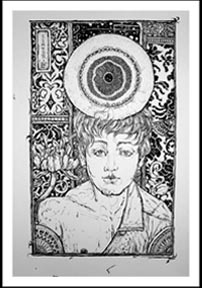
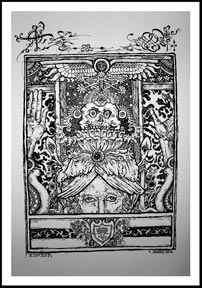
IN his first exhibition in 2010 (read my review of that show here), Gromyko Semper was both iconoclast and aniconist in his parodying and mocking icons of religion (especially Roman Catholic) and (especially religious) history. But perhaps cognizant of the fact that a parody of any sort of iconography qua a socio-political act necessarily manufactures an alternative system of iconography (iconoclasm/aniconism as its own iconography), opening thus itself to a counter-visual criticism of its visual criticism, Semper now turns to explore iconoclasm’s other option—postmodernism’s self-questioning and self-flagellating embrace of semiotics’ Marxist denouncement of both icon- and iconoclastic-touting.
     In his new works, Semper—in his usual woodcut-looking large drawings—takes off inspired by the art of Ukiyo-e and Albín Brunovský. (The drawings are teamed with responses in poetry by American poet William Nace, Jr. Nace’s postmodern poems likewise have a strongly Blakean flavour, heavily peppered with surrealism, Dada, contemporary music, and ironic mythologies urging a more eclectic Christianity—Nace is a former pastor. These literary poesies decidedly add extra layers of nuance to Semper’s drawings.)


ARMED with new visual takeoff points for composition, Semper came up with what he calls “spectres.” In turn, Semper is also now wont to quote Carl Jung (“Dreams are symbolic in order that they cannot be understood, in order that the wish, which is the source of the dream, may remain unknown.” – Psychology of the Unconscious), . . . when previously he would tend to deny Roland Barthes a chance, choosing instead to go for later Terry Eagleton, with a taste for what Umberto Eco calls the “closed text.” Semper’s more senior friend, the painter Marcel Antonio, had been a sounding board for the certainty/uncertainty of that early proclivity, and the art world now knows that Antonio’s art has always been an appropriation of narrative art’s habits (“manners”) for both their narrative (“closed”) and anti-narrative (“open”) values. Having said all of the above, then, one would find the title of Semper’s present show—in referencing ghosts of memory—as verily spot-on.
     Now, looking at the artist’s “portraits of memory” in the show, we’d notice that the characters in these portraits derive from our collective (international) memory of fairy tales, legends, myths, fables and other cosmological sources, each a jumbled child of mnemonics born of this memory’s confused splicing of their sources’ genes, producing thus a new community with its own potential symbology and semiosis almost independent of their parents’ own. With these new creatures, then, Semper transforms the societal Mnemosyne of a universal myth to become a Mnemosyne of the private, almost self-indulgent, ego (the artist’s as well as the viewer’s own reading ego).
     This drunk inward contemplation (and embrace) of memories comes in the manner of an occurrence wherein a hundred influences arrive upon it to such a level of simultaneity that one already forgets the specificity of those influences, rendering it thus impossible for the occurrence to properly acknowledge an influence for a specific/distinct virtue. In Semper’s new art, therefore, the public Mnemosyne is appropriated for the production of portraits of self-indulgence, a collection that ultimately spits on emblems and their fixed genes in favor of new visual species, with each creature wallowing in its own secret aspirations and desires, removed—if possible (as per Barthes’ wonderment)—from societal contexts. In the artist’s words describing these new-mnemonic creatures, “they are codices and syntaxes of my ideologies . . . they are what I am and what I am made of.”
     Additionally, with this new exploration Semper creates a series of new private icons whose feet nonetheless rest on the ground (“I made them look like icons but I took off the halo they should have had”), like new ideal mongrels of merely self-absorbed, sometimes funny, musings (“I wanted them to be ‘fernal’, as opposed to infernal, that is to say of this world and part of it”). Portraits these are, therefore, not of our respective selves as physical figures of vanity for social consideration and awe but of our respective inner selves as “mnemosynes” of honesty.
     Building thus these new alternative icons instead of scolding old ones, Semper engineers a new democracy of iconographies, which democracy and vouching for the private memory could be the better weapon against any iconography’s bigotry and consequent authoritarianism.


— May 20, 2012


Monday, February 27, 2012

Irony in Numbers


The STUPendous Show, February 23 to March 8, 2012 at Gallerie Anna, SM Mega Mall, is here being peddled as one hell of a, well, “stupendous show” by eighteen select young and not-so-young painters whose training derive from the College of Architecture and Fine Arts of the Technological University of the Philippines (TUP).
     “Stupendous” may sound like a modifier edging towards a hardsell approach to positioning an art exhibition, almost puzzling by the fact that this show involves merely paintings and not gigantic sculptures and fearsome installations. However, looking on and hard, could the point of this show lie in that very title? For to tag a bunch of quiet paintings on quiet walls in a quiet gallery with that very adjective usually reserved for extreme sports (or for hyped-up artists from the bigger universities) is an act that does carry with it the juice of irony, even tongue-in-cheek parody.
     And so, looking further at the individual pieces, and expecting to find nothing stupendous, the irony I allege seem to be truly present in the pieces. See here, for instances:
     Alrashdi Mohammad’s Yellow Spot In Nebulae illustrates through its titling act a signification or valuation method (for paintings, at least) that might proceed from mere updated allusions concerning present-day realities, in this case present-day science. However, what is here achieved seems not so much a mimicry of science illustration as a parody of painting itself, the way Franz Liszt might mock his own program music if he were to say his themes are but mere afterthoughts upon the finished products of the composition act.


     Meanwhile, Arden Mopera’s title Hitting Z Birds In One Stone for an oil piece on textured canvas may initially strike the viewer as mere forgivable bad English, but yet, what really is the canvas but itself another wall of a big rock cave on which painters paint their hunting stories? And those stories become fossilized/embedded in the rock and not with the rock, the same way pigments (the metallic ones of which are from rocks) are fossilized in the (textured) grounds and may even be pushing themselves further (via their oil) into the gesso-protected recesses of the cords of the canvas weave.


     Further, in Warrior, Mopera also seems to push forth a comment on portrait subjects as could-be warriors, with umbrellas for shields, who might best be shielding themselves from the visual interpretations of artists (and critics) who treat portraiture as a kind of visual social-science-labeling medium.


     Now, could Cesar Delgado’s Counting the Cost—despite some obvious or latent other statement—also be a comment on portraiture, presenting a disinterested subject that’s either ignoring, or unaware of, the painter and his concerns?
     There are other works in this show that manifest the ironies in painting today in more elliptical ways, elliptical for being disguised within established traditions. Chriseo Sipat’s Toxic Zone explores yet again the Pop art poetry of treading the line between oil painting and poster art, while Demosthenes Campos’ abstracts (Passage and Trail) classically extend the mixed media painting tradition of asking yet again where painting ends and where sculpture begins.

Chriseo Sipat – “Toxic Zone” – 36”x36” – Oil on canvas

Demosthenes Campos – “Passage” – 34” x 48” – Mixed Media on canvas

Demosthenes Campos – “Trail” – 37” x 48” – Mixed Media on canvas


     Then there are the likes of Joselito Jandayan, who seems to be swinging to and fro between magazine-illustration-like 3D drawing/modeling and the established visual poetic form commonly known as oil painting on canvas. In The Liar and the Beast, is Jandayan offering the argument that both the Expressionist and the Surrealist traditions of figuration are no more fanciful than the current fiction of extraterrestrial-beings-representation? In appropriating all of these traditional imageries, is Jandayan both paying tribute to those traditions as well as parodying/mocking them? Or is a tongue-in-cheek “alienization” of figures (as against a Francis Bacon seriousness) in order here? If so, isn’t that, qua attitude, by itself already a reality slap (in the Surrealist sense) on painting’s and painting collectors’ all-too-serious regard for any figuration of things blue and green and flesh-brown under the Sun?


     Lexygius Calip’s Substance (Series 1-4), meanwhile, is a mixed media on paper series that yet again represents the sculptural potential of painting, almost as if to remind us and reiterate the painting or drawing field’s kinship with the installation-art space.


     Finally, consider such approaches as Sam Penaso’s nationalistic dark earth tones upon an ethnic-faced subject ironically called “Annalyn”. This mugshot portrait, ladies and gentlemen, is not painted in dye, but in plastic acrylic—a painting medium from the 1960s Pop decade of the plastic boom. How can you be more ironic and subtly sarcastic than that? And what about a female name that combines the Latin “Anna” (19th-century Hispanic Philippines) with the American “Lyn” (20th-century Philippines)? How can you be more contextually expansive than that?


-- END --

Wednesday, January 25, 2012

The Romantic Lie: Desire, Ennui, Anxiety


Marcel Antonio's new statement at the Yuchengco Museum, February 6-25, 2012


In July of 2010, I posted a blog essay on the art of Marcel Antonio titled “Blue Funk’d Stories: The Expanding Art of Marcel Antonio” and coined the phrase-tag Blue Funk Erotica for Antonio’s art. I described Blue Funk Erotica as 1) unsmiling faces-derived figurative drama (primarily portraiture, then), 2) replete of appropriations or art-historical quotes, 3) suggestive (but only suggestive) of a narrative, 4) quasi-rebellious towards rigid allusions and painting titles’ guidance, 5) unpainterly expressionist, 6) of an in-a-trance mood as against a happy one, and 7) conscriptive of the painting viewer as peeper. “This erotica should stay around and keep us entranced,” I wrote, “being not so much one that tickles the groin as the kind that promotes the understanding that every face, gesture, object, color, and shape is a secret sex object and clandestine true story waiting to be told.” But also debunking a previous simplistic tag on Antonio’s art as “narrative expressionist,” I wrote: “In Antonio’s case, his blue funkism's ‘de-expression’, or ‘dis-expression’ and narrative confusion through the mannerisms of narrative imagery and titling, seems to be a produce of a Russian Formalist narrative bent on ‘defamiliarizing’ images and shapes towards a higher enigma. Thus his refusal to ‘express’.”


    The abovementioned blog started a dialogue between Antonio’s art as well as intent (of unintent) and my reading, culminating in a late-2011 production of a collection titled “The Romantic Lie: Desire, Ennui, Anxiety” which shall be shown this coming February at the Yuchengco Museum.
    This title for Antonio’s new series does not so much signal a change in his art’s direction as clarify where my reading is right and where it needs to be tweaked. For instance, while I opt for a Barthesian “variety of narrative possibilities,” Antonio’s pragmatic knowledge of his audience allows/welcomes two basic approaches to his art.
The White Ribbon
    The one approach favors rigid symbolist readings, especially as Antonio is himself attracted to the “monumental” (Antonio’s term) figure common among utopian-art compositions (e.g., Wagnerian glorifications, classical idealism, Nazi art, Stalinist totalitarian art, socialist realism, etc.) and advertising art imagery or the various idealizations of soft porn.
    But, for the other approach, Antonio acknowledges that I am right about his own efforts to frustrate, so to speak, all symbolist and narrative approaches, via experimentation with juxtapositions/relations and eclectic allusions. These experimentation, appropriations, and art-history quotes result in a dehumanized atmosphere, involving such stuff as machine aesthetics (steampunk, etc.) and the usual facial expressions of ennui and boredom, all moving towards Antonio’s intended postmodernist multiplicity of meanings. But the final result on each single canvas is an invite to a pseudo-narrative half-aware of this pseudo-ness, welcoming while parodying the various cultural and moral significations possible to professional and popular semiotics.
Ars Poetica
    In this sense, Antonio’s art would be self-described as anxious about the unknown, desirous of knowledge as a matter of course but likewise celebrating the ennui of knowledge’s elusivity, even the charm of that ennui itself alone. Ennui as both springboard and object of desire, then, visually fulfilled or illustrated on an Antonio-esque drama field.
    A final stamp to this anti-narrative effort to “recover the sensation of life” (Victor Shklovsky) is the artist’s devotion to the coloration of Diego Velázquez (recreator of the classics) or Chagall (dreamy Chagall) as well as to the latent abstract geometrics beneath all his pseudo-narrative stagings.
    I shall join Antonio in this exhibit with fourteen new poems in the exhibition catalog. Antonio also invited me to fill a curved wall he refused to use with my own paintings as the show's guest paintings. For which wall I did three shaped canvases, for a collaborative five-painting project with Antonio as counter-instigated by me. [END]


Monday, September 19, 2011

Miss Universes and "Universals"


1. No such thing as a stupid question, only a stupid situation

FIRST things first. There's no such thing as a stupid question.
     Even Lea Salonga's supposedly inane question to Miss Angola Leila Lopes (who'd go on to win the Miss Universe crown this year), dubbed by CNN.com feminist columnist Jessica Ravitz as "the dumbest question in the universe," isn't actually all that dumb if you put everything in context. "If you could change one of your physical characteristics," Salonga asked Lopes, "which one would it be and why?" According to Ravitz, ". . . it's absurd to be dismayed that a question like this would be posed at a beauty pageant. In my worldview, the mere fact that pageants exist is absurd. And I'm not alone."
     Well, I don't think she gets it. Context is everything, and, in this case, Salonga's question---actually all the questions were pre-written by the pageant committee and assigned each judge, says Salonga---was "a standard beauty contest query" that should only nudge us in our turn to ask about the motive behind the asking. Salonga hit the nail on the head when she wrote to CNN, "At the end of the day, it wasn't so much the question asked but the manner in which it was answered." After all, weren't all those questions asked during those Miss Universe pageants in the past designed to primarily test how a candidate might respond to future "stupid" questions that are going to be hurled her way in yacht parties she'll be attending as Miss Universe? Look at it this way, if you are to apply today for an account executive position at an ad agency, a position servicing that agency's stupid clients, and you wax philosophical during your interview about the world today as though you were Bell Hooks, I'm perfectly certain you wouldn't get the job. Precisely because no interviewer would probably have the mental wherewithal, in the first place, to ask questions about those areas of thought. Would anyone on those yacht parties hurl such questions as Bell Hooks might? Mm, maybe. Would there be people likely to ask the kind of questions Salonga just asked? Oh, I would assume---most definitely!
     My Facebook friend JCA wrote, "But I guess the shallowness of the questions is telling of how the organizers view their contestants." That's almost a given, similar perhaps to how designers and fashion show organizers view their adolescent models. But, again, that truth would still have to be put in context. After all, what use is the Miss Universe contest and winners to, say, Mr. Donald Trump, in the first place? The most creative and most introspective mind potentially useful to a long life of struggles in the business world never does win the "apprentice of the year" prize in Trump's The Apprentice (U.S.), does s/he, the same way that the best singer does not necessarily have to win the American Idol of the year plum. At the Miss Universe, it's not really the questions and the answers to any question that matter, it's the delivery, as Salonga rightly observed. Otherwise, the Miss Universe Q&A portion would be traditionally done in an interrogation room with cameras and would invariably last the length of a David Letterman Show interview, complete with a band to break the boredom. That is, a faux pas of an answer here could always be clarified or retracted there. Nobel laureates, after all, don't give quick answers, do they? We do not measure their intelligence by the swiftness of their replies nor by an absence of an "uhhhm, well". And as for defensiveness, Hillary Clinton's has no place in the Miss Universe contest, yet she's universally counted as one hell of a charm.
     To recap, the Miss Universe position is an account executive or account manager position. It's a low, starter's position in high society. There's no way Filipino ad industry stalwart Emily Abrera could now win a Miss Universe spot, is there? Again, I'm not saying that pretty-faced account executives can't possibly know anything about, say, Edward Said's postcolonial theories. I'm just saying they'd seldom be allowed to use that knowledge in their financial district jobs.
     But, still, there's definitely room for improvement regarding JCA's concern, reiterated by her friend Lea: "If the Ms. U. organizers are the ones preparing the questions, aren't they also underestimating the intelligence of their judges?" Well, Lea, Donald Trump underestimates the intelligence of everyone in the whole universe. But, then again, you and JCA are actually right. So that presently it might be useful to suggest to the Miss Universe pageant owners that perhaps, next time, Miss Universe contestants can come onstage in office attire for the Q&A portion. Or, if still in their gowns and in a pose, maybe while holding a wineglass, so for these candidates to be able to feel a sort of corridor meeting or yacht party situation feel in their heads, within which role-playing they could just be led to display their real brains beyond being those by merely smiling, nervous candidates onstage who have to pass a stupid test while a klieg light burns. This role-playing segment might have an effect likewise on the question-writing staff. . . . Now, even if we are to adapt this role-playing sort of Q&A segment to an in-their-swimsuits situation, supposedly a more frightening experience, the candidates can still be rendered wet and in the process of drying themselves with towels while being asked their questions, if only so that our ideal resultant could be achieved. I can assure you, such role-playing---whether with gowns or swimsuits---would break the ice. Because any candidate necessarily placed in a situation of utter nervousness when confronted with a question needing a quick answer cannot predict how her posing in front of a lot of people in an uncomfortable gown or Speedo can affect her alertness. Even a female Einstein would be trembling in that situation, and would likely feel as though she were in a Guantanamo prison being played on by a bunch of US Marines. When the most intelligent candidate fails to come through that nervous field, she gets demerits and ultimately fails to grab the crown. The merely charming and merely most diplomatic wins.

2. No such thing as an easy question, only easy situations

NOW let's go visit the question for Shamcey Supsup, who would become this 2011 contest's third runner-up: "Would you change your religious beliefs to marry the person that you love? Why or why not?"
     Some were saying this was a tad more difficult than the one given to Miss Angola. But, if my backyard statistics is right, most said this was way too easy, the too-obvious answer being a quick no.
     A Philippine Star write-up titled "How they would have answered that question" interviewed five former Filipina beauty queens. Interestingly, or not surprisingly, depending on where you're coming from, all gave that "obvious answer" in varying modes of articulateness.
     But was it really an easy question deserving of an easy answer? I believe an easier compound question would have been something like: "would you change your political beliefs to marry the person that you love? Why or why not?" But even then, putting aside the submission element in it, any answer is actually correct. "No," if one's beliefs are deep and passionate and utterly personal, "yes" if one's politics is shallow or if one has the heart of a spy. Now, having written that, I wonder if we could apply the same formula to the question for Supsup. "No," if one's religious beliefs are deep and passionate and utterly personal, "yes" if one's religious beliefs are shallow (cafeteria or cultural) or if one has the worldly heart of a multi-cultural syncretist. As for the submission part, there are a lot of reasons why one would do that. A certain tribe might require a would-be spouse's religious conversion for him/her to gain access to a conjugal wealth which might include a chain of hotels or oil derricks. Uhm, Mr. X, would you change your religion in order to marry Paris Hilton? Not that easy a question now, is it?

3. No such thing as one Universe, only universals

STILL on Supsup, my Facebook friend J- called his friends' attention to an ABS-CBN report which seemed to have been oddly written. The report zoomed in on Supsup's admission that her boyfriend had actually changed his religion for her. She is a "Christian", she's supposed to have said, and her boyfriend was formerly "Catholic".
     J- wrote: "Since when were Catholics not Christians? Don't get me wrong, I'm not a big Catholic but we were the first Christian church!"
     I had to correct J-, of course, with my modest knowledge of Christian history, thusly: "Actually the first Christians were the Jewish Christians before there were even Gentile Christians. The Jewish Christians included the Corinthians, the Ebionites, the Elcesaites, the Essenes, and the Nazarene/Nazoraean sect. Then, the first post-Jesus Jerusalem church was established by James the Just (some say with Paul), the leader of the Jewish Christian Church (Catholics insist with Peter as the "Rock" and "Chief Shepherd"). Then, even before Peter and Paul could arrive in Rome, Eastern Christianity was already being established in Asia Minor in what would later branch out to become the Church of the East, the churches of Oriental Orthodoxy, the Assyrian Church of the East, the Eastern Catholic Churches, and the Saint Thomas Christians. Even the Early Church in the Roman Empire, the prototype of the Latin Church of Constantine I (that was itself proto-Catholic), cannot be said to have already been the Roman Catholic Church as we know it today. The Roman Catholic Church, as we know it today, actually started when it was established by the emperors Theodosius I, Gratian and Valentinian II in 380 AD, when Latin Church Christianity (instead of the other Christianities, like that one by a group that would later be called Gnostic Christianity) was declared as the empire's state religion. This was at the same time that Damasus I was the Pope (who reigned till 384), when the Roman aristocracy started to take over the Church at the start of the decline of the Roman Empire. Damasus commissioned the Vulgate translation of the Bible, the early Roman Catholic Bible, and called for the Council of Rome during tensions with Bishop Nectarius of Constantinople."
     Notice that I always modified "Catholic" with the adjective "Roman". J- Facebook-liked my comment and thanked me.
     J-'s friend A- joined me, saying: "Of course not. You're not the first Christian church."
     Notice A-'s use of "church". She didn't write "yours is not the first . . ." but "you're not the . . ." Bear that in mind, because Christian authorities would repeatedly teach that the church is neither that building by the marketplace nor that institution with a flag but the people, the following of Jesus. That following can exist without a church building or a flag, and thus A-'s use of the word in her clause "you're not the first church" makes complete sense.
     J-'s friend JC chimed in, refuting my and A-'s offers, saying: "The first Christian church was the Catholic Church. Other Christian churches were just offshoots and splinter groups. Isn't this true, Kuya J-?"
     Another of J-'s friends, JBC, also joined us: "Regardless, all Christians believe in one Judeo-Christian God. Why do we have to argue about who came first when, at the end of the day, we all believe in the same divine entity?"
     JC had to add this: "Sure, dissension happened. But the original is the original."
     "Go ahead," I wrote. "If you think the Roman Catholic Church was established in 12 or 30 AD or thereabouts instead of in 380 AD by Theodosius, suit yourself, JC, I wouldn't be surprised. Nonetheless, JBC is right."
     J- Facebook-liked this, but so did JC, adding: "Thank you!"
     JC also Facebook-liked another comment from another of J-'s friends, Father V-, when the latter entered the conversation. Father V- wrote: "That's quite a splintered understanding of what the church is," referring to my splintered understanding. "When one associates the Church with a mere political faction, because Paul did this or Constantine did that, one cannot get the full picture of what the Catholic church is all about. This is seeing the church as a mere institution. But the Church is more than just a human society, and it's more than just a title. The Church, Catholic and apostolic, began when Christ brought it into the world, founding it upon his apostles, especially upon Peter. This is the Christian Church, which is only One, and which subsists in union with Peter and the successors of the apostles, who have kept the faith whole and entire despite the passage of time, despite the errors of the centuries."
     This is true, too, at least for 2nd-century claims to universalism and for claims to continuity from the church of Jesus' Apostles, for even when Protestants use the word "catholic" (with a lower-case letter c), they also use it not to refer to the Catholic Church alone but broadly to the Christian Church (regardless of denominational affiliation) and all believers in Jesus Christ all over the world, across all ages. Therefore, put aside Father V-'s Roman Catholic "especially upon Peter" emphasis and Father V-'s institutional claim that the Christian Church as One subsists in union with Peter. Put aside all the Romanism, and you'll be able to imagine the idea of inclusivism in catholicism (even via Catholicism), wherein one can embrace even those who believe Mary Magdalen was Jesus' right hand instead of Peter (Gnostic Christians, for instance).
     Now, JC loved what Father V- wrote, writing: "Yes, Father. Got it! We are the original."
     Well, if universalism (or "catholicism") also means being inclusive and Father V- would nod his head in agreement, then obviously JC couldn't have gotten it.
     I wrote, "@Father V-: Would that it were so," and I meant that the Catholic Church was not also---or was not firstly---a political entity with a divisive history and policy, "then the world would have been a much better place."
     "JC and A-," wrote J-, now seeming to have changed his mind about his post, "being 'first' is beside the point, is it not? The decorous bearing of the matter is, we are a Christian church, too. Right? :)"
     JC Facebook-liked this.
     "Ok," he wrote, "the Catholic Church is a Christian church. Christians are followers of Christ. Catholics follow Christ and his teachings . . ." and so on. I thought that was that with JC.
     Father V- came back: "By the term Catholic, meaning universal, we mean that Christians follow and believe all of the doctrines taught by Christ handed down to His Apostles by way of Scripture and tradition, teachings necessary for one to fully heed the call of Our Lord to holiness. In this sense, to be truly a follower of Christ, one needs to be catholic, universal."
     JC and another A- (A2, let's call him) Facebook-liked this. Actually, there's almost nothing worth protesting against in this statement if only the Father wasn't confusing "Catholic" with "catholic" in his explanation, almost as if to hide a logical fallacy (the 'God is love, love is blind, therefore God is blind' kind of logical fallacy) to service a metanarrative.
     I had to call A-'s reaction to this: "@A: By your comment above, I gather you're Protestant? If you are, then by Father V- you do not follow and believe all of the doctrines taught by Christ blah blah blah, you can't fully heed the call of our Lord. You are not a true follower of Christ. The only way by which you can be that is by becoming C/catholic, by becoming 'universal'."
     Father V- promptly answered my satire with a confirmation: "Well, basically that's what being a disciple is, right? It basically means following everything that the Master did and said and taught. Otherwise, what kind of disciples are we? By the word 'Catholic' (Father V-'s capitalization, not mine) I'm referring to a reality, not a denomination. We don't call ourselves catholics (Father V-'s lower case, not mine) for nothing. The name Catholic stemmed from the fact that in the Reform worked by Luther his followers broke away from Christian teaching and praxis, selecting those that were in accord with their personal beliefs and ideals and rejecting those with which they were not in accord."
     JC Facebook-liked this. Well, put aside the Father's confusing catholic with Catholic, as if catholicism or universalism is exclusive to Catholics. Lay aside the fact that Martin Luther was mainly questioning the papacy's corrupted adherence to the bright ideas concerning Purgatory and the selling of indulgences. Put aside the fact that Luther was only seeking reforms (thus Reformed) from within instead of from without, but kicked out instead by the corrupt Catholic hierarchy of his time. Put aside the fact that to imply in our time that Pope Leo X's indulgences salesmen were following Christian teaching and praxis is tantamount to qualifying and reiterating Pope Leo X's virtue on these same indulgences-selling during his time, and thus for our time. Put aside the fact that to call Pope Leo X's corruption as "within Christian praxis" could reintroduce a scandal. Put all those aside, . . . if only because Father V- was not yet finished with the Luther question.
     He continued: ". . . this is far from the logic of discipleship; the disciple is bound to his master insofar as his master is concerned. Either he accepts his master totally, and all of his teaching and the practices that he has taught him, or he is no follower of his. This is perfectly logical, and this is more so true of Christianity. When the Lord came among us as man he showed us the Father; by His teaching and actions he instituted the norm by which his followers would be known . . . this was entrusted to his Apostles, who---because of their ministry in the Church of Christ---continue the presence of Christ on earth."
     I see. From a self-contradictory explanation of catholicism as exclusive to Catholics (contradictory because while claiming he was not speaking of Catholicism as a denomination Father V- was at the same time equating catholicism with loyalty to Catholicism, in which case JC was right in Facebook-liking Father V-, for it would seem that Father V- does not include inclusivism as part of his "catholic" context), Father V- now moves to a second stage, that of equating Luther's hatred for Pope Leo X with a hatred for Jesus, as if Pope Leo X's sins and Jesus' virtue were/are one.
     Father V- was not done.
     He continued: "There is no need to be polemical here, by the way, Jojo Soria . . . what I'm trying to express is, that being a Christian necessarily means that you have to accept all of the teachings and commandments of the Lord, whether they are in accord with one's taste or not. This in Greek and in English amounts to being---what it means to be---"katholikos" or catholic. . . ."
     "@Father V-:" I wrote, "If there's no need to be polemical, then why have you and I become polemical? Was it perhaps because there was a need for it? Where did that need come from? Could it be that the polemics just grew from nowhere? If it did, then do you mean that when I write I'm being needlessly polemical, but when you write you're not being polemical but yet need to be for my enlightenment? If that is your approach, I'd fully understand the consistency."
     "Hahaha," my Facebook friend J2 butted in at this point. "Polemics," she wrote, "all but polemics."
     I wasn't exactly sure whether J2 was referencing Father V-'s polemics, my polemics, both our polemics, or the entire humanity's polemics, so I just Facebook-liked what she wrote, since it looked polemical in itself. :)
     "No," Father V- instantly wrote, "I'm just explaining things from my end. Honestly, I had no intention of being polemical. In fact, aside from the fact that I just wanted to share my view, I got interested in the topic, since expressing it here also enlightened things up for me. As a student of history I'm beginning to see that there's more than meets the eye with the term 'catholic', that its being fundamentally synonymous with 'Christian' was penned even long before the Reform; it goes way back to sources of the Christian faith."
     I Facebook-liked this.
     "Anyway," Father V- continued, "if it seems to you that we're being polemical to each other, then this won't serve us any good . . . aside from the fact that I was just trying to give reason to anyone who calls me, to give an account for the hope that is in me (cfr. 1Peter 3:15), I was beginning to see it as a stimulating conversation, both based on reason and on faith, which always need to go hand in hand in the search for the Truth that liberates. Anyway, frankly I got something from this. . . . Peace :-)"
     I Facebook-liked this.
     "Pacem in terris," I wrote, "as Pope John XXIII would have it. :)"
     Father V- Facebook-liked this. JC didn't.
     Well, not everyone among Roman Catholics ever liked what John XXIII and his Second Vatican Council tried to introduce ("to restore unity among all Christians, including seeking pardon for Catholic contributions to separation"; "to start a dialogue with the contemporary world"). Not everyone in the Church likes the idea of reconciling or breaking bread with Protestants and the Orthodox churches, much less with other religions which Pope Benedict XVI controversially is trying to realize today in spite of his conservatism. Pope Paul VI, who would continue John XXIII's mission, was another Vatican liberal, but not everyone heeded his apology for Pope Gregory's having turned Mary Magdalen into a prostitute via a simple sermon, if Catholics today are even aware that that apology and a series of revisions concerning Mary Magdalen ever happened. Not everyone in the Church liked John Paul I too, who didn't last long in the papacy. And John Paul II, who voted against a lot of tracts in John XXIII's Second Vatican Council, is probably the most loved Pope in the Roman church today, partly perhaps for his having continued facets of John XXIII's efforts, as in the area of trying to reconcile with the Jews and other Christian sects. Pope Benedict XVI, a close confidant of John Paul II, seems to want to continue John Paul II's efforts to extend just facets of the Second Vatican Council tracts---specifically that one seeking a dialogue with other religions. . . .
     But if Popes could marry, if Pope Gregory VII hadn't required clerical celibacy, then John XXIII would probably have been the sort of Pope who wouldn't mind marrying a Protestant. And I don't think that would be because his religious beliefs were shallow or that he was a syncretist. He was, rather, the one most open to differences, the one with an open ear.
     In short, he was the first to respect the various catholicisms (universalisms), in effect fulfilling the embrace of the catholic doctrine of inclusivism. He was the Vatican's Stephen Hawking, who might have theorized that there is no one universe, but universes which finally are all the same, wherein hypertravel through cosmic wormholes can be done. He was the Vatican's company merger guru.

NOW, what has all this got to do with Shamcey Supsup and her formerly-Catholic boyfriend?
     Well, picture that scene again when Hollywood actress and contest-appointed judge Vivica A. Fox asked Supsup her question. Then, picture that moment when she answered the question. Now, put her boyfriend in her place, in a sort of scene from a Mr. Universe pageant, with him being asked the same question. His answer, of course, would be something like "I already did."
     If Supsup can embrace her boyfriend's secular heroism or sacrifice at the same time that she would preach an adherence to religious loyalism among females, we could surmise that Supsup is either sexist and another religious bigot who considers other religions as crap (Roman Catholicism perhaps as anti-Christian instead of Christian for putting Church laws above Christ's laws, according to some denominations), or . . . she believes there is no one Universe but a bundle of valid universes that could access one another in mental hypertravels via physical wormholes of acceptance. Matter turns into anti-matter and becomes matter again in some other universe, then vice versa, all perfectly acceptable. Nothing is illusion anymore, everything is embraceable. So that by answering her question at the pageant with what she had or what she could come up with, she was also recognizing that stupid questions are really only stupid situations, that easy questions are really only easy situations, and that the Miss Universe is really just a construction of various beauty queen claims to various valid universals. Remember, the first requisite of beauty pageants is congeniality, not basketball-like adversity. Its objective heaven includes yacht parties. So, therefore, you just tell people what they'd want to hear and save them the trouble of religious faux-universalist noise.
     That quick choice I can understand. Even Facebook-like. [END]


Photo of Shamcey Supsup borrowed from REUTERS/Nacho Doce as used at http://www.ibtimes.com/articles/213018/20110913/miss-philippines-2011-shamcey-supsup.htm


If you wish to comment on this article but the character-limited box below does not accept your comment, please chop your comments into a paragraph per posting. Sorry for the Blogger glitch still being fixed. Otherwise, message me via http://www.facebook.com/profile.php?id=639696704

Wednesday, September 14, 2011

Why Are We Writers Shallow?: A Voltairean Exploration


My friends' Facebook walls have been calling everybody's attention to F. Sionil Jose's quoting of a well-loved former senator in his latest column essay on Philstar.com titled "Why we are shallow". Okay, the essay has my attention, and now---having nothing better to do---I'd like to offer my own conjectures regarding what's behind all this rampant shallowness Jose is talking about.
     But first things first. The idea of Filipino shallowness that visited the novelist-columnist came from a friend of his from another Asian country, an idea which initially floored him. Then, recently while watching a presentation of Asian dances with former Senator Leticia Ramos-Shahani, Jose observed that there was but grudging applause from the audience for the stylized movements of a stately Japanese dance while a near-standing ovation was accorded to the energetic jumping in the Filipino-cum-Vietnamese tinikling. Jose said anyone can learn the tinikling in 10 minutes, and Senator Shahani was supposed to have asked, "Why are we so shallow?"

Well, let me see, we have been shallow for centuries.
     It was probably one of the things the Japanese hated us for, the reason perhaps why they treated us and our women like the Chinese during World War II, because we couldn't understand their dances which they didn't have the time to elucidate on for our modest collective comprehension. Meanwhile, our long-standing enthusiasm for the tinikling only demonstrated this alleged shallowness, because---as Senator Shahani would know---we as audiences often approach the dance with merely the eye of tourists, laughing and clapping only at the dancers' meager feat of avoiding the bamboos. Senator Shahani, being a Sorbonne University Doctor in Philosophy in Comparative Literature, would know that there is more to the dance than what my favorite cooking television personality could drunkenly and metaphysically say about it in the Vietnam episode of Anthony Bourdain: No Reservations Season One. There is definitely something about the rich presence of thick bamboos in this feasting dance, as well as about the allusion to the tikling bird of the rallidae species and the tikling farm traps made of bamboo, the erotic and taxing accelerando rhythm in the fourth quarter of the dance, its relation to Philippine martial arts and tribal war dances, its possible role in Leyte among Bankaw's people prior to the Bankaw Revolt. However, we are not all trained to be dance historians, much less as semioticians, to ever get---or want---anything more than the fun we're already getting from the tinikling at face value. In fact, we didn't all have that privilege of getting to know anything about our own dances, much less the Odori, and so we remain shallow.
     As Jose's foreign friend would say, this shallowness is manifest even in our major papers. I'd read the Philippine Star, for instance, and what would I get? Apart from F. Sionil Jose's column, there's practically nothing to read in there except the comic strips, the classifieds for preferably female applicants, and the boring crosswords and sudokus. It's a total waste of recycled paper. Another Star columnist, the poet and novelist Alfred Yuson, was probably wryly acknowledging this shallowness in his newspaper after he was indirectly asked for his opinion about Jose's column and assumptions: "Shallow shallow me. Shallow me wherever you may be... tra-la-la...," he said.

Our universities and colleges are all to blame for this epidemic of shallowness.
     Instead of putting much emphasis on the culture of Late Antiquity, they spend too much time teaching our preppies everything about the binary structures of HTTP cookies used to hack the CIA headquarters or eBay with, or the way Florence Nightingale would assist a doctor performing a burn debridement or escharotomy, which all totally mean nothing to either Heraclius or Phocas. Look at the Hindus, for instance, even while often high on bhang lassi their continuity with their past would be retained through the centuries, so that even today you can see sacred cows still plowing their own dung on the cobblestones of Jaisalmer Fort. And the Buddhists of Thailand---who up to today can perform sacrifices of not dirtying one's soul with the mud of modern economics, relying solely for their food on the age-old charity of a modern-day profiteer with a store. So why, oh why, don't our universities and colleges bring back all that Greek that up to now is being studied in Greece, or all that Latin that up to now is still being studied at Pontificio Seminario Vaticano, for God's sake?
     The classics teach us wisdom. The Web teaches us nothing but wiki-knowledges about protons and American Idol winners. Thus the arrogance of TV personalities who have been fed these wiki-knowledges by their scriptwriters, mistaking these bits for wisdom. The classics' wisdom lead us to Western culture and all its metanarratives of superiority over tribal wisdom, which we---if we could only immerse ourselves in these holy waters---could in fact use to build our own counter-reifications.
     This failure of ours to appropriate the wisdom of Western culture has in fact led us to a level of ignorant arrogance, a broadcaster's type of arrogance, that is unable to see the role each of us is playing in the system, be it the system of government or the system of citizenship. All we can do now, therefore, is lean on the luxury of slogans and abstractions and sweeping views that are averse to the devils in the details. Thus the vicious cycle of crab-criticalities that are, being crab-criticalities, by themselves averse to criticalities. We thus end up hurling invectives at each other, calling each other stupid and ignorant and shallow, while each is without a desire for the hard task of discoursing further on rococo details of qualifying truth (the way either Michelangelo or Michel Foucault would feel happy about) regarding the fisherman's son's inability to comprehend the basics of TESDA's electrician's course or his ability to call Mike Enriquez's confused conservative or progressivist politics crap.
     We have chosen to be Westernized and yet not Westernized enough. Our embrace of democracy fails Karl Popper's dictum of owning likewise the responsibility of accepting "obsolescence" when it comes in an open society. We hold on to our animist faith concerning the divinity of our persons assigned seats of authority, be it as government authorities or culture authorities, and own nothing but a confirmation bias in favor of our ability to call anyone and everyone shallow. Western culture, if only we studied it well, would have taught us the rigors of rationalism, so that instead of sweeping conclusions regarding ourselves we could slowly tackle each man's behavior the way Spinoza tackled God, as an individual expression in a dynamic equation. Because of this inability, we have been reduced to behave like writers pretending to be sociologists, with nothing but the rhetoric of fallacies that we mistake for social science. We are thus rendered shallow---unable to see who we are, those mere writers, and the limits to what we can do.
     And if only we had Romanized ourselves well, the way South Korea has Americanized itself well, we would have armed ourselves with the capacity to hurl crockery at the quackery of Restorationist and evangelical voices on TV. If we had been Romanized enough, we would see---beyond Latin-American liberation theology---the superiority of Vatican to these discards of Calvinism and the Great Awakening. Look at South Korea, its perfect Americanization has shaped the prosperity theology of the Yoido Full Gospel Church. Meanwhile, our Catholicism is not as strong as the death threats of an Opus Dei follower on the artist Mideo Cruz in our supposedly open-ended society.

Thus, we are rendered shallow.
     And so we fail to see the shallowness of media as product of the subconscious plan of the local Illuminati to keep the status quo, wherein education remains the privilege of the post-Gomburza children of former caciques and public education is the shame hurled on the laps of Jesus' working class.
     We are rendered shallow. We can't use our pens to expose the real identities of the jokers on morning radio who are on a secret mission to destroy the seeds of social liberalism in the service of network-owning bosses with holding companies with interests in the fuits of conservative elitism.
     We are now eternally shallow. We can only choose to ignore the fact that all that entertainment fodder is what goes on in the drawing boards of corporate profiteering and, in surrender, we proceed to ourselves write shallow exegeses about our own shallowness, contributing in effect to the perpetuation of such profit-motivated mass dumbing.
     We: you, with me, are forever shallow. So we can only spit on our neighbors who can't understand our essays in English. We are totally shallow. We can only complain about their Tagalog-based intellectual incapacities deriving from our missionary and patronizing teaching-in-English failures. We are shallow. We can only ignore the fact that we are not Belgium divided into a French-speaking territory and a Dutch-speaking territory but Belgium divided into several languages inside our every territory and spot. We are shallow. We can only close our ears to the fact that linguistic differences are often also class differences. We are shallow. We can only close our eyes to the reality that the lower class aspires to become the middle class and upper class, and the upper middle class and upper class aspire to become Americans and Europeans.
     We are, safe to say now, shallow, and so choose not to write about the cost of sending our kids to schools that teach how to read, about the price of books, the language of books, the stupid marketing and distribution of books, the inaccessibility of books, the technological variations on the concept book.
     We are shallow. We continue to debate on the virtue of books, hoping to find enlightenment for everyone, while the sidewalk downstairs aims for the depths of our garbage, deeply hoping to find bread. [END]


UPDATE:On September 26, 2011, Jose uploaded a new Philstar.com column piece titled "A reply to you out there who disagree with me": click here to read.