THE prolific
Filipino ceramic artist Ugo Bigyan (he prefers to be called a mere
"potter") has always espoused a 1:1 ratio for his entire output, the
one part being on the side of business, the other on the side of art. This is
not an alien doctrine to most successful artists, although some of them would
deny having placed an equal premium on "commercialism". Bigyan's
commercial items (he supplies three Glorietta stores, among many other mall
stores) are neither crass nor condescending in their exploiting and feeding a
supposedly less "academic" market. Quality is distributed to all
classes and markets, that's his production's policy. And as for my use of the word
"exploiting," we must remember that in marketing management the word
is seldom used in its negative, irresponsible sense. And as for my saying
"supposedly less academic," I must apologize as we must likewise
remember that the market of higher-end artistic products are not necessarily
always academic in their approach to sensual objects of purchase.
In a capitalist environ, or -- if you will -- a free
enterprise system, all art necessarily becomes commercial. Or, to be more
blunt, all art is commercial. Anti-commercial art can be categorized into two:
one patronizing a limited (therefore unprofitable) "cognoscente" class market
which may actually include both learned and merely pretentious elements, the other
exercising a form of rebellion against the role money plays in art, or
otherwise flaunting a freedom from the necessity of selling. Some so-called
installation art (a genre which blossomed in the '70s) have not always decried
the money influence, for we might remember that the US' National Endowment for
the Arts and such other funding institutions offer hefty sums to artists who
wish to practice in this traditionally non-profit genre. But some who have been
vocal in their installation-art practice about the supposed corruption of
painting and sculpture have been able to declare their stand from positions
that either maintained day jobs or otherwise solicited maintenance fees from
their family wealth or from private contributions.
I happen to be in a similar art practice, with my six online books of poems and one online short story collection, all being products sans profit. My day job not only allowed me the weekend luxury of writing but likewise access to office internet facilities. :-) When Dr. Zhivago (or rather, Boris Pasternak) wrote in a poem "And for your noble work no payment claim,/ Your art alone your wage", I wonder what sort of poet was in his mind -- a doctor-poet like him? A carpenter-poet of social realism subsidized by the state? Pasternak's medical practice, a half-commercial venture, sustained his art, making his art one with a possibly quasi-commercial source. The only true anti -commercial art, therefore, is the one that's produced only once and with the intention of dying, to be thus intentionally disabled from doing any further art or any future acceptance of a remuneration. Art that wishes to make further art would indeed solicit the question as to how one might be able to keep on doing it, what should sustain the artist's nutrition through the weeks. In the same way that no communist can survive in a capitalist society without partaking of the processes of capitalist exchange (including one's labor as one's capital), so the anti-commercial artist cannot claim freedom from commercialism until he leaves the face of that same consumer market's capitalist processes.
Of course, what is often disparaged as commercial is art that has been downgraded, perceived to have compromised with -- to satisfy the profit motive of -- producers, patrons, and/or dealers. A sellout art, it's often called. Or the patron or dealer himself is the one labeled as a commercial dealer, as if there is such an animal as a non-commercial one. Now, such downgrades as we've mentioned do not necessarily produce lesser art. Picasso's ceramic plates have often been touted as some of Picasso's commercial works, never mind that a pejorative radical criticism would eventually regard Picasso's entire body of works as wholly commercial for their patron-friendly colors. Picasso's plates would now command serious study from many an art critic or art aficionado, and so does that mean that the commercialism has disappeared by virtue of their academization?
I happen to be in a similar art practice, with my six online books of poems and one online short story collection, all being products sans profit. My day job not only allowed me the weekend luxury of writing but likewise access to office internet facilities. :-) When Dr. Zhivago (or rather, Boris Pasternak) wrote in a poem "And for your noble work no payment claim,/ Your art alone your wage", I wonder what sort of poet was in his mind -- a doctor-poet like him? A carpenter-poet of social realism subsidized by the state? Pasternak's medical practice, a half-commercial venture, sustained his art, making his art one with a possibly quasi-commercial source. The only true anti -commercial art, therefore, is the one that's produced only once and with the intention of dying, to be thus intentionally disabled from doing any further art or any future acceptance of a remuneration. Art that wishes to make further art would indeed solicit the question as to how one might be able to keep on doing it, what should sustain the artist's nutrition through the weeks. In the same way that no communist can survive in a capitalist society without partaking of the processes of capitalist exchange (including one's labor as one's capital), so the anti-commercial artist cannot claim freedom from commercialism until he leaves the face of that same consumer market's capitalist processes.
Of course, what is often disparaged as commercial is art that has been downgraded, perceived to have compromised with -- to satisfy the profit motive of -- producers, patrons, and/or dealers. A sellout art, it's often called. Or the patron or dealer himself is the one labeled as a commercial dealer, as if there is such an animal as a non-commercial one. Now, such downgrades as we've mentioned do not necessarily produce lesser art. Picasso's ceramic plates have often been touted as some of Picasso's commercial works, never mind that a pejorative radical criticism would eventually regard Picasso's entire body of works as wholly commercial for their patron-friendly colors. Picasso's plates would now command serious study from many an art critic or art aficionado, and so does that mean that the commercialism has disappeared by virtue of their academization?

(photo from http://thealavigna.blogspot.com/2012/07/lately-ive-been-so-curious-about.html)
SO, commercialism and non-commercialism ought not to be the cop-out idea of a dilemma that attempts to explain bad and good art. Bad art will remain bad, commercialized or not. Sure, it's poor quality that dictates our suspicion of a high degree of "commercialism" or corruption. But what if the cappuccino barista thought he/she was making really great coffee? In contrast, the artist who designs his art for both critical and commercial success ought not to be faulted for the virtue of finding mass appeal appealing. Conversely, the bad artist who has been patronized by an infinity of buyers who thought they knew what was great art, may have found his mass appeal appealing. But it must not be waylaid that the real reason we hate the bad artist's art is not because of the patronage but because of the absence of criticality around and within his success.
All art is commercial, especially from the buyer's point. When your buyers are happy, they call you "non-commercial," an artist full of integrity. But since intrinsically all art is positively commercial whether we like it or not (whether we're aware of it or not), so-called negative "commercialism" or corruptibility in artists or coffeeshop restaurateurs becomes nothing more than a subjective view in the art and in the practice of art-buying, a cop-out explanation for our bad judgment. And since a buyer knows full well that all art is commercial, he ought not to complain that he got the sad end of a bargain, responsible as he ought to have been as a judge qua buyer.
Recently, there's been this brouhaha over a supposed mercenary spat between a Church's authorities and the folk painter Nemesio Miranda. Miranda, commissioned by the Church elements to do a painting for the Epifanio de los Santos Avenue Shrine for the Holy Virgin, allegedly had been consistent in bidding for a high price (PhP400,000 plus) for the simple cleaning, and a much higher price (PhP1.5 million) for the full restoration, of a painting he made for the same Shrine. The Church allegedly haggled with Miranda (news the painter denies, claiming the Church could have actually negotiated). The spat came forth when the Church elements concerned decided to proceed with their own restoration, claiming they couldn't afford Miranda's quotation. The Church elements said that they had every right to do with the paintings whatever they wished since it was theirs, that they paid for it. Miranda cried foul, saying it was his artwork, and the restoration omitted certain parts of the original (no, practically erased these parts with a white daub). It was his concept, he said, and by the restoration his concept was denigrated.
Clearly, Miranda (and his defenders in the press) missed the point. Forgetting he had consistently been acting the part of the artist aware of his commercialism. Asking to be paid for the restoration of his own concept already presupposed his concept to be less valuable than the payment, or coevally valuable as the payment, Then, Miranda insisted it was an ethical question. Suddenly, Miranda was on the side of artists who keep on claiming that their art is purely conceptual and only secondarily commercial. Obviously, Miranda failed to see that the issue was a purely commercial question. The question is this, which I shall henceforth illustrate by way of an idea for an art project:
I will create a painting and exhibit it at a gallery. Before anyone can buy it, I shall buy it myself. Then I'll paint over it. Then I shall exhibit the redid painting, go through the same process of buying it myself and ruining it. And on. And on. Till I tire of it. I can do whatever I want with the piece because I bought it and therefore it's mine. I bought it and re-bought it, and every time I bought it I redid it. Also, I can do whatever I want with the painting because I was the artist. That would be the height of ethics, then. Permission unnecessary because nobody asks permission from oneself. Especially if that oneself is both artistic and commercial over his concept.

MARKETING
men offer us this good advice: make good products as a first step to market
success. However, in the same breath they'd also say, if there is no market for
our products we can always make one. From Piccaso, let's fast-forward to the '70s and '80s. Why several artists marketed their stuff as "ugly paintings" in
the '80s, or Bad Painting in the '70s, whether from a disgust for a burgeoning
trend using, say, patron-friendly pretty coloration in many of the paintings of
a decade, or whether from an awareness that there was a growing part of the
market that had that punk rock-inspired disgust and had become bored with
paintings in general, I do not remember. Was that de Kooning-ness a
demonstration of the opposite of selling out? How many of their paintings were
sold in the process? If they got sold, were the non-commercial painters
unwitting participants as waiting commodities of an in-progress commercial
marketing process?
And as for art that is not art, so to speak, as in
"popular cinema" (as against "art cinema" or film festival
cinema), there exists such prejudicial tags as suspense thrillers, horror
films, romantic comedy, and so on. Quentin Tarantino delivered the loudest
statement at Cannes on this issue with Pulp Fiction, demonstrating
that poetry (linguistic as well as visual) is possible within established
Hollywood pop cliches and formats better known as pulp (meaning
"cheap"). Katheryn Bigelow has done it too in her lesser-known films.
Recently, in Kill Bill, Tarantino demonstrated further that
there can be such a thing as art-for-art's-sake cinema that utilizes Hollywood
formats and formulas. Not to use them for some serious
artistic end, really, other than to appropriate them for some redirection of
audience reactions from these same-but-twisted formats or genres. These
utilizations, by the way, while of artistic value can also be regarded as pure,
blind entertainment, if only for the reason that the elements used were by
themselves major parts of the source formats' entertainment value. Here, then,
is the corollary idea that Hollywood formats may perhaps have always been more
about the art of their genre than the stories and the plot; therefore, actions
within may have been more important, to audiences as well as the filmmakers,
than what all the action was about and for. Therefore, not exactly more
commercial than Art.
Consider that up till Kill Bill, such art-for-art's sake claims inside Hollywood were still only being associated with French and German short films (filmic films) that showed a lot of those blurs, scratches on the film, editing flairs, double exposures, swinging cameras, and so on, that seemed fraught with the obsession to bring painting and Pollock into the photoplay medium as materials, even while Kill Bill is not filmic. Tarantino had to bring art cinema out of the art cinema houses. Tarantino thus achieved for the turn of the millennium what the pop artists of the '60s (Warhol, Lichtenstein, etc.) achieved with kitsch, pushing pop and kitsch and the trampy up to a level wherein they became valid material for artmaking.
But maybe I'm wrong. For how many Hollywood houses marketed their films for the special FX involved, or for the martial art choreography developed therein? The only difference, however, was that instead of these films embracing such elements for "art"-making, the elements were enjoyed for themselves. And would that make for art? Perhaps not. Nevertheless, here is still not a question of the difference between pure art and commercialism, but simply the difference between art (which is entertainment) and elemental entertainment as an "art" or art.

Consider that up till Kill Bill, such art-for-art's sake claims inside Hollywood were still only being associated with French and German short films (filmic films) that showed a lot of those blurs, scratches on the film, editing flairs, double exposures, swinging cameras, and so on, that seemed fraught with the obsession to bring painting and Pollock into the photoplay medium as materials, even while Kill Bill is not filmic. Tarantino had to bring art cinema out of the art cinema houses. Tarantino thus achieved for the turn of the millennium what the pop artists of the '60s (Warhol, Lichtenstein, etc.) achieved with kitsch, pushing pop and kitsch and the trampy up to a level wherein they became valid material for artmaking.
But maybe I'm wrong. For how many Hollywood houses marketed their films for the special FX involved, or for the martial art choreography developed therein? The only difference, however, was that instead of these films embracing such elements for "art"-making, the elements were enjoyed for themselves. And would that make for art? Perhaps not. Nevertheless, here is still not a question of the difference between pure art and commercialism, but simply the difference between art (which is entertainment) and elemental entertainment as an "art" or art.
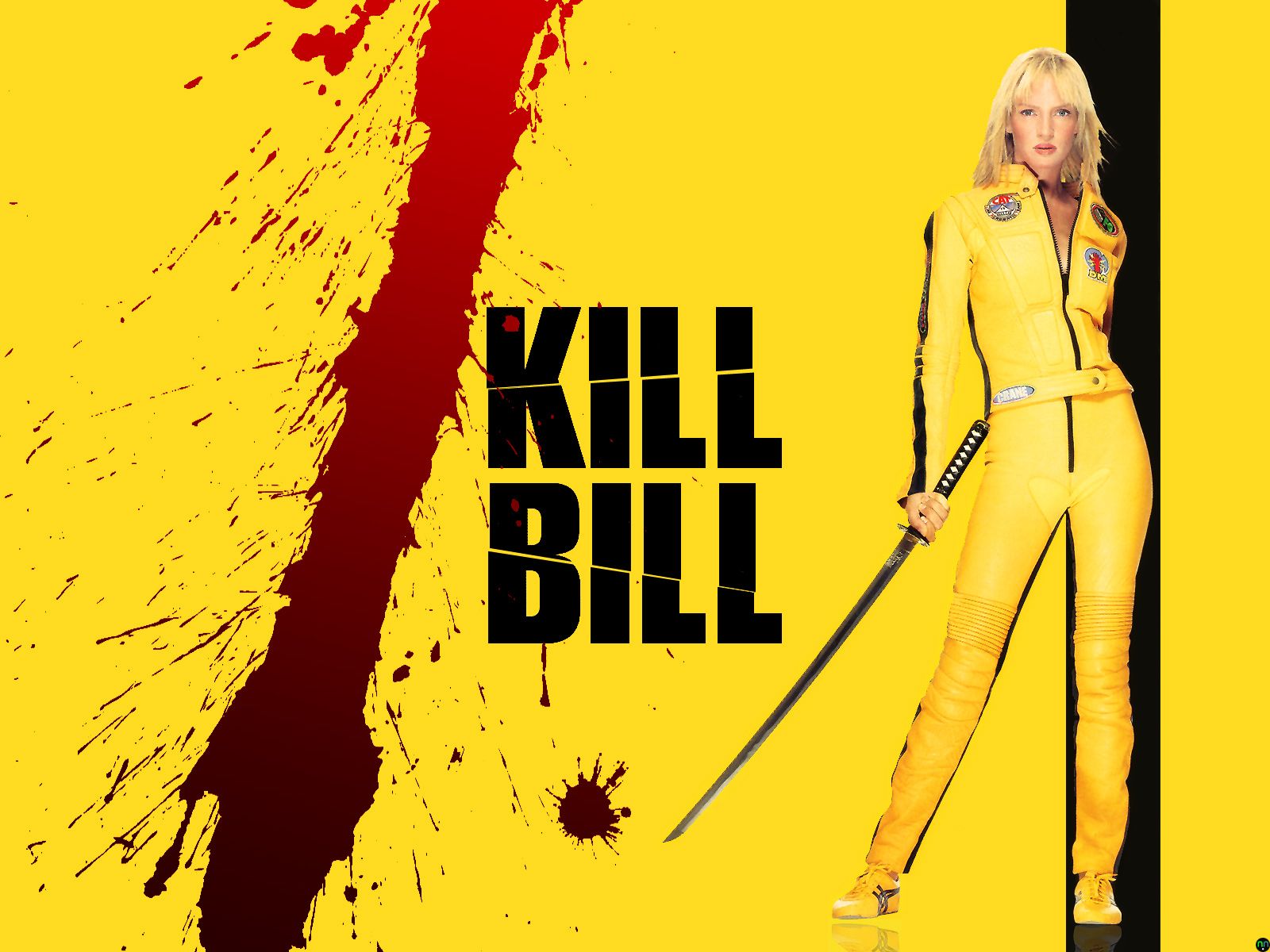
wallpaper for Kill Bill
And so, we may say art remains art when it utilizes the little arts of the world (special effects, cinematographic craft, etc.) for holistic expressions. But should we say that in holism is integrity and in its absence is selling out? Nope. Creating "shallow crafts" is not equivalent to commercialization, either, the same way that commercialization is not the devil that ruins art. Consider kitsch, a longtime enemy of art and good taste and one of the products of commercial merchandising interests: there may be a lot of art that are simply bad and derivative and deserve to be lambasted as kitsch, but using (consciously or unconsciously) the kitschy sensibility as material for good art is a different thing altogether. Laying Mona Lisa tiles on one's kitchen walls may be kitschy to one critic, but to another critic doing so and doing it in extremis to come up with a so-aware or not-so-aware contextual statement on the kitsch-ification of the Mona Lisa in the age of Roman tourism would be using kitsch practice as material and thematic content for an art concept. It is possible for such art to attract a wide audience, which will not make it commercial, or attract no audience, which won't make it non-commercial.
Statements and concepts abound in good art today, whether in
New York or Berlin or Manila, and many if not most of these are for sale. In
the same manner that novelists sell their novels and filmmakers their films,
painters get rich by the commercialization of their art. But the critical wrongness
of a painter's heavily-selling art would not be due to its commercialization
but due to its own wrongness. Any form of "non-commercialization"
would certainly not redeem it, critically.
All good art that struggled in the market place is
still commercial art that simply didn't compromise to a formula of
commercialization but chose a different commercial direction, say, a long-term
profit over a short-term one. As Tarantino has loudly shown, one can be
"commercial" to achieve good art out of that commercialism. The
painter Piet Mondrian produced a similar resultant with his work in a probably
less-aware fashion. Five large paintings by Mondrian and his statement would
already have been clear in that age when art was still covered by journalism. But
no, he had to paint more, and still more, all under that same reductive thesis
of his! "Commercialism"? Perhaps. But in the end he
demonstrated that the simplest, most basic formula can attain a rich number of
variations to ultimately make up a collective output that can be regarded by
the forgiving as one single artistic epic of an opus, profit-motivated or not,
profit-motivated and not.
Many an artist have been practicing what business and
product marketers refer to as positioning. And this with a brave struggle.
Having come up with a painting that moved him, one may have decided to do more
of the same and so position himself as a painter of a type of painting similar
to what he's produced. Commercial? Perhaps. But so is everyone else in choosing
a career, a success path, an area of expertise. Therein lies the motor of our
merchant society within which we make and sell art. It should be commendable
enough that each of us struggles with a brave fight.
Commercial motivations, admitted as so or not, subconscious
or vocal, have produced the best and the worst commodities in our time. An
inescapable capitalist curse, we say. And yet "commercial
motivations" have not been absent in communist states; in fact, these same
motivations had kept many there working for societal or state approval.
So, it really shouldn't be hard to understand that the
artist's own profit motives are no different from the artisan's or the
engineer's or the critic's. But not a few painters hate themselves for being
pawns of a commercial system, and they ought to be made aware of the virtue
(over the evil) within it. Some, meanwhile, in oft-unaware and thus not so
self-critical positions towards the commercial facets of their art-selling, can
only be looked upon in awe, in the same way we feel stupendously gratified by
the coffeeshop-owner's sincerity in personally making our cappuccino (his mind
off the fact that he'd personally take our payment later). When you love your
coffee, do you call it a commercial cappuccino? It is when you hate it that you
should.
SO, commercialism and non-commercialism ought not to be the cop-out idea of a dilemma that attempts to explain bad and good art. Bad art will remain bad, commercialized or not. Sure, it's poor quality that dictates our suspicion of a high degree of "commercialism" or corruption. But what if the cappuccino barista thought he/she was making really great coffee? In contrast, the artist who designs his art for both critical and commercial success ought not to be faulted for the virtue of finding mass appeal appealing. Conversely, the bad artist who has been patronized by an infinity of buyers who thought they knew what was great art, may have found his mass appeal appealing. But it must not be waylaid that the real reason we hate the bad artist's art is not because of the patronage but because of the absence of criticality around and within his success.
All art is commercial, especially from the buyer's point. When your buyers are happy, they call you "non-commercial," an artist full of integrity. But since intrinsically all art is positively commercial whether we like it or not (whether we're aware of it or not), so-called negative "commercialism" or corruptibility in artists or coffeeshop restaurateurs becomes nothing more than a subjective view in the art and in the practice of art-buying, a cop-out explanation for our bad judgment. And since a buyer knows full well that all art is commercial, he ought not to complain that he got the sad end of a bargain, responsible as he ought to have been as a judge qua buyer.
Recently, there's been this brouhaha over a supposed mercenary spat between a Church's authorities and the folk painter Nemesio Miranda. Miranda, commissioned by the Church elements to do a painting for the Epifanio de los Santos Avenue Shrine for the Holy Virgin, allegedly had been consistent in bidding for a high price (PhP400,000 plus) for the simple cleaning, and a much higher price (PhP1.5 million) for the full restoration, of a painting he made for the same Shrine. The Church allegedly haggled with Miranda (news the painter denies, claiming the Church could have actually negotiated). The spat came forth when the Church elements concerned decided to proceed with their own restoration, claiming they couldn't afford Miranda's quotation. The Church elements said that they had every right to do with the paintings whatever they wished since it was theirs, that they paid for it. Miranda cried foul, saying it was his artwork, and the restoration omitted certain parts of the original (no, practically erased these parts with a white daub). It was his concept, he said, and by the restoration his concept was denigrated.
Clearly, Miranda (and his defenders in the press) missed the point. Forgetting he had consistently been acting the part of the artist aware of his commercialism. Asking to be paid for the restoration of his own concept already presupposed his concept to be less valuable than the payment, or coevally valuable as the payment, Then, Miranda insisted it was an ethical question. Suddenly, Miranda was on the side of artists who keep on claiming that their art is purely conceptual and only secondarily commercial. Obviously, Miranda failed to see that the issue was a purely commercial question. The question is this, which I shall henceforth illustrate by way of an idea for an art project:
I will create a painting and exhibit it at a gallery. Before anyone can buy it, I shall buy it myself. Then I'll paint over it. Then I shall exhibit the redid painting, go through the same process of buying it myself and ruining it. And on. And on. Till I tire of it. I can do whatever I want with the piece because I bought it and therefore it's mine. I bought it and re-bought it, and every time I bought it I redid it. Also, I can do whatever I want with the painting because I was the artist. That would be the height of ethics, then. Permission unnecessary because nobody asks permission from oneself. Especially if that oneself is both artistic and commercial over his concept.

patron-delighting Warhol painting
(photo from https://www.pinterest.com/pin/104286547593608990/)
And if
I can do this, I shall have demonstrated a truly non-commercial art that -- in
the manner of Tarantino -- shall have successfully used commercialism as my
material and thematic content. I might thus achieve for the middle of this
decade what the pop artists of the '60s (Warhol, Lichtenstein, etc.) achieved
with kitsch, pushing pop and kitsch and the trampy up as valid material for
artmaking, in my case pushing what I'd probably immodestly perceive as the work
of my own genius (reworked every time in a kind of self-criticality) as valid
material for a portrait of artists' passion for concepts. But I won't be so
hypocritical and claim freedom from commercialism, for I shall remain aware
that what made me buy my own paintings and abuse them was a certain luxury in
my convent, free from hunger. I will thus not deny that I can afford any
quotation from any expensive school of art that shares my taste (since that
school of art that shares my taste is my own, cheap self).
If all art is commercial and we cannot escape it, from
living with it in art, then, we can see one final enveloping moral here.
In the commercial world, one is judged by what he sells. Also by what he buys.
In this sense, then, who we buy is a reflection of ourselves. Who we choose to
sell to reflects who we look up to. We are judged thus, but mostly by
ourselves, in the now and in the later. And the reason why there is no law
against an art patron's right to ruin an art piece he bought (save a contract
of sale specifying conditions) is this issue of trust between the buyer and the
seller who in essence have been morally (not legally) married to each other by
their similar taste in art. Being married thus, we can judge the relationship
by the presence or absence of a continuing happiness in it. For, as we said, if
you like your coffee, that coffee can hardly be called a commercialized cup of
coffee. The sad thing is with the Church, which hates divorces. For it could
have been made aware that when one enters a marriage, one also risks the
possibility of future separation. Such happened between the above Church
elements and Miranda.
So, let's get back to the legality of it, of this separation. The difference between a wedding and a buyer-seller partnership is that in the latter there are no conjugal properties, there is only a product sold which was the product bought. In such a commercial arrangement, the critical appreciation of the buyer has made the art. The buying was a form of criticality without which commerce or exchange would not have been possible. It's not the other way around. All art is commercial and an art's value is relative to a market's criticality. An art's success or failure depends on this criticality. Therefore, this criticality is Lord; it is not the seller who is. This surrender by the latter is demonstrated by the act of exchange -- the money for the artwork. Once out of the artist's hands, the artwork becomes the sole possession of the criticality. If a millionaire buyer chose to leave my oeuvre in the rain, that was his prerogative and privilege.
But what about the issue of good art and bad art? Those, too, are subsumed within the dynamics of a market, not within the dynamics of production. Again, commercialism is not the evil factor, it is in fact the sole measure of a market's degree of criticality. [END]
So, let's get back to the legality of it, of this separation. The difference between a wedding and a buyer-seller partnership is that in the latter there are no conjugal properties, there is only a product sold which was the product bought. In such a commercial arrangement, the critical appreciation of the buyer has made the art. The buying was a form of criticality without which commerce or exchange would not have been possible. It's not the other way around. All art is commercial and an art's value is relative to a market's criticality. An art's success or failure depends on this criticality. Therefore, this criticality is Lord; it is not the seller who is. This surrender by the latter is demonstrated by the act of exchange -- the money for the artwork. Once out of the artist's hands, the artwork becomes the sole possession of the criticality. If a millionaire buyer chose to leave my oeuvre in the rain, that was his prerogative and privilege.
But what about the issue of good art and bad art? Those, too, are subsumed within the dynamics of a market, not within the dynamics of production. Again, commercialism is not the evil factor, it is in fact the sole measure of a market's degree of criticality. [END]


