Monday, August 17, 2009

Honesty in the Lie of Entertainment


Willie Revillame


SO MANY people are once again lambasting entertainment TV host Willie Revillame for carrying on with his fun-for-the-masses crappy noontime show Wowowee, not because they now finally agree with the band Itchyworms’ series of songs satirizing such profitable variety show shit; no, they are finally coming out to curse all of Revillame’s expensive houses because, horrors, he, Revillame, carried on with his noontime fun while Corazon Aquino’s funeral cortège (updates from which were intermittently being broadcast on TV) was on its way to an eternal memorialization in the planet’s history books as one of the most visited and watched cortège curious inhabitants of this planet ever saw. Revillame has already apologized, and the Aquino family has accepted the apology, him and TV host Kris Aquino being channel-mates and all, but—alas!—Revillame’s critics won’t have any of it. They want Revillame’s head on a plate, they want ABS-CBN to remove his name from its payroll, they want the authorities to run after his expensive cars and homes, minimize his mini-mall, they want to see him impoverished and finally slighted by his alleged “Guest Relations Officers” (“girlfriends regularly overlapping,” one envious/righteous wit of a gossip, whose name escapes me presently, once said).
     All the above mass anger is understandable anger if we’ve loved Corazon Aquino or the cause she had represented and represented us in. But, you see, this is also understandable behavior among those who merely want to exploit the anger and use Revillame’s (deservedly) maligned image as a scapegoat for their own guilt.
     I dare defend Willie Revillame the entertainer, though I have nothing but deep hatred for TV shows that kowtow to the poor’s beggary principles, feeding on their feudal patronage of TV hosts as well as mayors and presidents who throw away crumbs as the version of socialization self-righteously deemed better than real socialization itself. Hate those shows, I do, those TV shows and those political ones, for their alibi that it’s better to throw crumbs to a few lucky ones while the government or management behind them awaits the coming of a comprehensive miraculous change in their souls. Somehow I liken it all to a charity foundation built for the possibility of hefty tax rebates, or to carrying runny-nosed homeless babies for political photo ops to upgrade an image. The end for all those is always huge but latent profits. . . . But now, for fear of being labeled a communist (as is our wont), I’ll say I hate it/those not because I hate profit itself but because I smell dishonesty in the concept, see a faked desire to help a beggar with a 1,000 pesos while seeing a reluctance in its ability to donate to a cancer ward with a 1,000,000 of the same currency.
     But this is not where I would like to waste my blog space and my readers’ time on. It is somewhere else I would want to pooh-pooh convention. I would rather piss my reader off with my defense of Mr. Revillame than incense or bore him/her with my corny dialectics on the virtues of true Christianity or real (moderate) socialism.


I DARE defend Mr. Revillame for the simple reason that on that very day the nation saw him as verily crass and unprincipled, I saw nothing but honesty and integrity. While hundreds of Aquino-the-oppositionist haters displayed tears on TV as if to exploit the cameras for the nursing of their profiles as human souls, I saw Revillame as the one—the only one—devoid of hypocrisy.
     I do not mean to infer that in truth and in fact Revillame has not a gram of sympathy for Corazon Aquino as a person and as a cause, or has none of that for her family, or—worse, as others would have it—no sympathy for any dead person, oh no. I only mean that Revillame struck me that day as the very personality that he has always been, one who has no qualms about being a selfish child forever while also one who finds it not so hard to apologize like a self-conserving child an hour or day or week later, one—in fact—who would repeatedly preach about the virtue of childishness himself (correct me if my memory serves me wrong). Revillame did not change himself for the occasion, and the reason is simple: he does not know how to. Or, to be even more generous to the man, he probably by nature prefers not to.
     Many say Revillame is evil. I would beg you to pardon my disagreement, for I’d say you likely fail to see that his goodness lies in his honesty, inclusive though that may be of his honesty about his dishonesties. He constantly confesses his crassness, his business motives, his women, and so on and so forth, even his recurring evil. It’s a virtue so rare among us who delight in our own latent daily crassness and unfair price hikes who would later face the mirror to convince our own shaved masks that “you’re good.”
     Contrast Revillame now, then, with those who sent flowers to Aquino’s vigil, wore black or white (or beige) or yellow to chat with those at the vigil, and made offered sound bites for TV or radio microphones extolling Aquino’s virtue, doing thus while deep down were thanking the god Mammon for extracting yet another leader of street rallies, or—days or hours or minutes later—would go back to the very acts and thoughts against which Aquino could only want to live more to fight, armed with words of defiance and dedication her enemies had hitherto been giggling at.


I SEE not much of a political person in Willie Revillame. When he talked to the TV host Cito Beltran on the latter’s now-defunct talk show on ABS-CBN News Channel when the former had his falling out with ABS-CBN bosses before Wowowee was realized, he (Revillame) did not hide his selfish profit motives, almost bragging about how much of a business genius and conceptualizer he was and is. On that show, I saw Revillame as a guest on Bloomberg Television serious about making money, not someone pretending to be a “man of the masses” on Fox News. The man is a hungry businessman, no lying about that. If he is a deceptive persona, I’d say he is no more a liar than the bulk of advertising produced for TV.
     Revillame is a child. A grandchild at his grandpa’s wake might be missing his grandpa, but he would still be harassing his sister playing jacks in front of the funerary band playing grandpa’s favorite Glenn Miller marches, still be carousing with his kid gang-mates even as his grandpa’s cadaver parches. But that child, that child is not ever going to be a falsity. Nor a fakery. Nor a visiting figure of hypocrisy. A child cannot falsify his child-ness, cannot fake his childishness, can’t pretend to be a child. Often a child pretends to be an old man, and what we do is laugh at him and he laughs back in response to our giggling. Stupid, yes, but the child knows. He knows he is not an old man. He knows, too, that he’s bad at faking. Often he finds out he’s not good at lying.
     In contrast, again, the hypocrite and the fake will—during a night at a wake or during the duration of a funeral parade—believe, while the wake or parade or funeral ceremony lasts, that he/she has loved the dead. And he/she wouldn’t want to believe—or wouldn’t want people to believe—that he/she hadn’t.


THE ANGER against Willie Revillame (while curiously forgiving ABS-CBN itself, as always) continues. This is understandable if we had loved Corazon Aquino or one of the causes she passionately represented us in. But, you see, this is also understandable behavior for those who merely want to exploit the anger and use Revillame’s image as a stand-in for their own momentary shame. [END]


Saturday, August 8, 2009

Politicians’ Artists of the Philippines vs. Artists’ Artists of the Philippines


Yesterday at the rally at the National Commission for Culture and the Arts office protesting the National Artist of the Philippines title awards given to C-movie filmmaker Carlo Caparas and theater organizer Cecile Guidote-Alvarez, National Artists and sundry joined Imee Marcos and Irene Marcos-Araneta in condemning the “presidential prerogative” exercised by the Malacañang Palace in picking this year’s awardees.
     Somehow I thought something was wrong here. F. Sionil Jose and Bienvenido Lumbera, among others, voiced concern over the sacrilege. The award was now tainted, they said. It was not honorable anymore. Their argument was simple: the Palace shouldn’t be deciding on things like these, that was the consensus, if only because the Palace was wrong in picking two artists the protesters thought didn’t even deserve to be called artists.
     Here’s what I thought. I thought this has already happened before and will happen again. What happened before was a not-too-loud controversy over then-President Joseph Estradas conferring the same title on the songwriter Ernani Cuenco for the year 2000. Artists wrote emails to each other to solicit protestations against this award for Cuenco, an Estrada friend.
     I remember writing a post on this subject at Flips, a mailing list for mainly Filipino-American writers. And what I wrote was basically the same opinion I carry now (see this mailing list post, which I uploaded as a blog post here in 2000, with the necessary adaptation and updates).


And so it happens again. And it will happen again. All because we can never agree on who should be declared a National Artist and why, in the same way that professors in a multicultural university in the United States find it hard to agree on which authors can be featured in their school’s curriculum. In our case, artists as a supra-collective will have their standards, politicians (ruling and not) their own. The worldly will have their opinions, the lumpen majority their searched words. The fine arts student will be very articulate, debating a take by a bus-driver fan of a popular art’s hyped-up stalwart.
     Kumukulo na ba ang dugo niyo? Sige, mag-Tagalog na tayo.
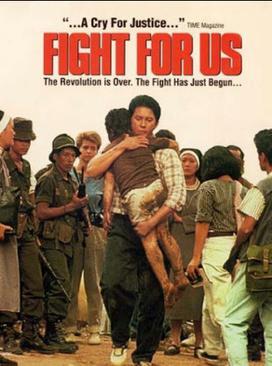
     Ang National Artist of the Philippines title award na tinayo ni Ferdinand Marcos noong 1972 ay isa lamang sa ilang manipestasyon ng pag-na-nationalize ng anumang gobyerno at ng mga authorized” na tao sa sining. Tulad ng NCCA at Cultural Center of the Philippines, ito ay nag-iimpluwensya sa sining mismo na gumawa ng safe art, ng sipsip (sucking-up) art, at di paggawa ng mga Orapronobis (Fight for Us) o anumang hindi magugustuhan ng nasa kapangyarihan. Ang rehimen ng ruling class na nag-iimpluwensiya sa ruling party ay mag-iimbita ng mga protest art kung ito ay laban lamang sa mga nakalipas na rehimen o di kaya'y pumoprotesta sa mga kalaban niya ngayon.


     Oo, mga paret mare, ang pagtalaga ng national art taliwas sa tunay na sining ng mga tao (na ayaw nating amining di natin nabibigyan ng sapat na edukasyon at tayo lamang sa mga maririwasang pamilya ang nakakaintindi sa mga National Artists na ito), at ang mismong pag-nationalize ng art, ay maihahalintulad natin sa pag-nationalize ng isang TV station. Paano kaya kung sabihin ni Gloria Arroyo na mula ngayon ay kakaibiganin na niya ang mga may-ari ng ABS-CBN at gagawaran niya ang ABS-CBN News Channel ng official tag na National Channel of the Philippines? . . .
     Bakit ba gustong-gusto nating magkaroon ng National Artists gayung meron naman tayo, o at least kaming mga karaniwang tao sa barangay? Meron tayong/kaming sariling national artists, di ba? Bakit ba gusto nating bumalik sa mga siglong ang artist ay nangangailangan ng patron na nasa kapangyarihan? Oo, kung tayo sa barangay ang hahayaang pumili ng taong ipagtatayo natin ng bantayog bilang simbolo ng ating sining, oo siguro at malamang si Caparas pa rin ang pipiliin natin. Ngunit kung yun man ang mangyari, tayo ang pumili. Walang magsasabing hindi iyon ang repleksyon ng ating kaalaman. . . .
     Unless mag-agree naman ang mga nagbabasa nito na mula ngayon ay mga artists na lang dapat ang boboto kung sino ang dapat maging National Artist. Wow. Kung iyon nga ang mangyari, ako naman ang tatayo at mag-ra-rally at magpapapadyak sa pagsabing: Alisin niyo ang salitang National. Palitan niyo ng Artists para maging Artists’ Artist of the Philippines. At mag-contribution na lang ang mga artists para sa perpetual stipend ng mga National Artists na ito at nang hindi na manggaling pa ang gastusin sa coffers ng republika, ng nasyon.
     Itoy hanggang matanggap natin ang katotohanan na, kung susuriin, ang karamihan sa mga itinuring nating National Artists ng ating bayan ay sa totooy Artists of the State (or of the Regime). At walang masama rito kung bibigyan ng angkop na titulong gayon. Dahil magkaiba po ang Estado at ang Nasyon, lalo na sa kulturang inukit ng representative democracy. At bagamat ang isang Estado sa ilalim ng isang representative democracy ay gawa at inatasan ng kanyang Nasyon na magpasya para sa lahat, malimit ding ang isang Nasyon sa loob ng isang Estadong ganito ay may kulturang di maintindihan ng kanyang elitistang Estado (na pinapatakbo ng mga elite) na paulit-ulit na ibinoto ng naloloko niyang walang-kamalay-malay na iba-ang-kulturang Nasyon. [END]


Friday, August 7, 2009

Kanino ba ang isang nasyon ng mga walang alam sa art? (Whose is a nation of fools about art?)


photo from http://bulatlat.com/main/2009/08/11/national-artist-fiasco-%E2%80%98defiles%E2%80%99-culture-%E2%80%93-critics/


1. Hindi ke Imelda, hindi ke Mikey, na mga walang alam

HABANG sinusulat ko ito, in-progress na ang rally sa Cultural Center of the Philippines (CCP) o National Commission for Culture and the Arts (NCCA) kontra sa pagdeklara kina Carlo Caparas, na isang direktor ng mga tasteless na “massacre films” lang naman daw, at NCCA director Cecile Guidote-Alvarez, na nag-organize lang naman daw ng Philippine Educational Theater Association (na nagpatalsik din naman daw sa kanya) at ng mga safe art para sa sponsorship ng NCCA.

photo inserted 2013, borrowed from http://www.pep.ph/news/39909/supreme-court-clarifies-stand-on-nullification-of-national-artist-awards-says-caparas-et-al-may-still-seek-title

     Tama. Dapat talaga ang nasyon ang pumipili ng nasyon-al artist nila, hindi si Imelda Marcos (na nagpatayo ng CCP) na hindi alam ang gusto ng tao, hindi rin ang aktor na si Mikey Arroyo na walang alam kundi ang gusto ng kanyang mga tao. Kaya nung sinulat ng kolumnistang si Conrado de Quiros na siya'y tila natawa noong ideklara ni Gloria Macapagal-Arroyo ang national days of mourning para kay Cory Aquino---dahil hindi raw kailangan ng deklarasyon ng Malakanyang para magluksa ang bayan sa pagkamatay ng kanilang minahal---naisip kong ganun din dapat ang ating lohika pagdating sa mga paboritong artist ng ating nasyon (inanunsyo ang pagkapanalo ni Caparas at Alvarez isang araw lang bago namatay si Aquino): dapat walang dekla-deklarasyon. Ang artist na nasyonal ay nasyonal na artist, period.

One of Caparas' "massacre films" [photo from https://www.facebook.com/108377235916862/photos/a.124042927683626.32695.108377235916862/124043224350263/?type=3&theater]

     Parang Grammy Award sa Amerika, nakakatawa. Although hindi aaminin ng NARAS, hindi ka qualified sa isang Grammy plum kung di ka umabot sa certain number of records sold, lalo kung di ka pop-market friendly. Kung ganun, ibig sabihin ihohonor ka ng peers mo kung hinonor ka na ng tao. Ba’t pa kailangang ihonor ka ng peers? Ngunit buti pa ang Grammy me primary sa tao bago umabot sa parlyamento ng mga taga-recording industry. Ang masaklap nga lang para sa mga ayaw ke Caparas, dito---kung saan ang magandang edukasyon sa arts ay binibigay sa mayayaman lamang---ay talagang si Caparas ang siyang magugustuhan ng tao kumpara sa mga Brillante Mendoza dyan sa sulok kung magbobotohan ang tao. Kung ganun, ibig ba sabihin ang Malakanyang ay nagpakamasa na rin sa pagpili ke Caparas?
     Kung ganun, sana sinagad na ng Palasyo. Sa theater, halimbawa, ang popular sa tao na si . . . Imelda. Di ba? Di hamak na mas magaling siyang artista kesa ke . . . she could easily shed a tear after an "I . . am . . . sorry," even though we never heard her say anything like that. In short, sa pag-arte siya'y kumbinsing; kumbaga, gustong-gusto ng madla at maaaring manalo uli sa Leyte kung gugustuhing tumakbo. National artist ka ng masa, madam! Isantabi mo na yang delicadesa at tanggapin mo, kahit ang asawa mo ang nagsimula ng lahat ng 'to! Ikaw rin for architecture, for giving us the leaning tower called the Manila Film Center that the nation never got to use!! (Sino pa ba ang mga mahilig magmanipula sa kung ano dapat ang hitsura ng sining at kultura natin, sino? Awardan natin!)

2. Ang artist ng mga walang alam sa aming barangay

YEHEY! Sabi ng iba, mamamatay na raw ang National Artist of the Philippines title awards! Salamat naman! Dagdag lang sa gastos ng taxpayer yang stipend sa mga artist na yan na hindi naman namin kilala dito sa aming barangay!
     Nasa kalsada ako kanina and made a sort of barangay survey and, guess what, Caparas won hands down as the artist of the people of our barangay's street over Brillante Mendoza, Lav Diaz, Jeffrey Jeturian (Kubrador), Raya Martin (IndependenciaManila), Raymond Red (Sakay), even over the veteran directors Maryo J. de los Reyes (Magnifico) and Carlos Siguion-Reyna (Ang Lalaki sa Buhay ni SelyaLigaya ang Itawag Mo Sa Akin). Caparas is an artist of the people, thus of the nation, no doubt about that, in the same way that Jinggoy Estrada would be the preferred statesman to this nation over somebody like the late Raul Roco. This nation may not be the nation the intelligentsia would rather see, but let's face it---this is the monster we helped create. By standing by and allowing our 20th-century governments to design an elitist education system so that we can enjoy our neighbors' stare of envy when the elite school's bus stops in front of our gates, we helped create that culture wherein Mikey Arroyo's movies would be the nation's preferred entry pick for the Cannes Film Festival. Compare this to the German public's regard for Werner Herzog or Japan's for Jūzō Itami and others. . . . But having said that, I'm signing up in the petition to withdraw Caparas’ award. How come?
     Perhaps because waiting for the perfect would make me an enemy of the good. And a lot of the artists marching presently are good artists. And Caparas movies are ba-a-a-a-a-a-d.

3. We’re paying for their stipend, di niyo ba alam?

BUT for the long term, I declare that this National Artist crap is really crap because a waste of tax money. It's either we hear a National Artist conferment on somebody the nation of academics loves but whom the lumpen nation has never even heard of, or on a maker of grindhouse films for double features back-to-back with '60s soft porn films for a dingy moviehouse under a Manila Light Rail Transit System structure for a nation of fools, or on an NCCA-based promoter of safe art.
     But then again, ladies and gentlemen, can't we agree that SAFE ART IS THE NATIONAL ART?? Mabuhay ang national safe-art artists we all deserve!!
     Then again, a National Artist cannot be declared, didn't we argue that already? Again, a national artist just is, period. Jaroslav Seifert became Czechoslovakia's national poet without anybody declaring him so. Pablo Neruda to Chileans and even Argentinians, same.
     Also, a multicultural nation cannot have a national artist, let alone a National Artist, but only niche artists. Why do we even have this illusion that we are a nation? Blog writers and their readers debating on Facebook is more of a nation now than the passengers on the Manila Metro Rail Transit System on a rush hour morning. National Artists, my ass. National Artists, my ass on a moviehouse toilet bowl full of phlegm and janitors' feces!

4. Kanino ba ang nasyon? Hindi niyo alam?

MY favorite artists need not be national artists. Why should Gloria Arroyo's favorite filmmaker and safe art organizer be our favorites, too? Is she a Queen Elizabeth conferring her blessings on her Shakespeare? Many would not even call her their president.


Wednesday, December 15, 2004

A Lessened Hobbesian View on Our Inferiors


photo borrowed from http://www.covershut.com/Television-Covers/43317-Mr-Bean-The-Animated-Series-Grin-And-Bean-It-Disc.html


I DO NOT know why the Mr. Bean animated series on cable TV’s The Disney Channel is popular with kids. Maybe it’s because cartoon drawings function like doll or mascot figures, referencing reality distortedly and thus not realistically, which makes cartooning the more honest portrayal of The Real qua progressing problematique in our continuing learning. Cartoon people likely come on not like office work problems, but more like crossword or sudoku puzzles we definitely need.
    Mr. Bean is an evil but fumbling character with the face of a stereotypical retardate. That personality combine (evil/funny) is probably what makes him amiable instead of despicable, enhanced of course by a recurring atmosphere that declares the "saner world" to be no less evil and corrupt than Bean's funny person.
    Now, if by Thomas Hobbes we can admit that man is by nature an evil animal only struggling to be virtuous (for one realized reason or another, which reasons still couldn’t make him selfless), then in the light of a world requiring bits of evil in order to survive Mr. Bean must be to adults a symbol of relative goodness in spite of his evil, if only because a face of sheer innocence or ignorance or retardation or stupidity might be considered exempt from the Hobbesian jungle-smart premise. Yes, Mr. Bean not the merely laughable but the ultimately amiable---amiable because how we wish we could be as innocent as he in both our rancorous mistakes and our cunning!
     Or is it the spirit of comic animation as an aesthetic that allows us to forgive evil, being a spirit where evil can get away with it because it, this evil, has become an animation or exaggeration of a hated object, that is to say, has been made demented or stupid or impossible?
    Christian authorities mostly stand by this declaration of innocent sinfulness, as being forgivable, in contrast with the knowledgeable's sinfulness as being unpardonable . Apart from that, what are animated beings but beings inferior to our presently perfect real-human selves?


BUT there are moments when we become "inferior" to ourselves, and to others watching us in those moments we become manifestations of saintliness. Perhaps God is an aesthete, then, for after watching way too many movies I’ve come to the conclusion that man is in his most saintly and beautiful state during those hours of extreme vulnerability, whether these span a few hours or---as in the case of the realistic character Robinson Crusoe---a few years. God should win at least a billion best director awards for giving us these images of saintliness and beauty based on true stories.


photo borrowed from http://www.boaterexam.com/blog/2011/05/real-castaways.aspx

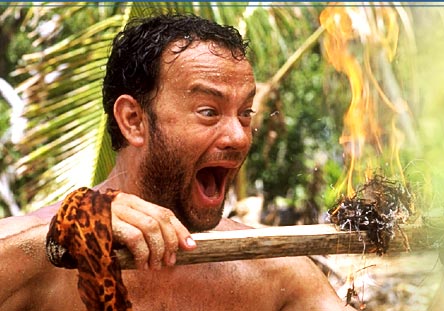
    In the movie Cast Away (where the businesslike among us might notice only the production value of putting some all-star cast away for a while in making this one-actor blockbuster of a movie), the hero played by actor Tom Hanks is amiable from the start, even while at his most cranky-boss frame of mind. It seems like this modern-day Robinson Crusoe wasn’t exactly unaware of his crankiness as a put-on, consciously allowing underlings to make fun of him so he could get a desired result of projecting amiability on his person and extracting efficiency in others due to this combined amiability and fearsomeness they read in their boss.
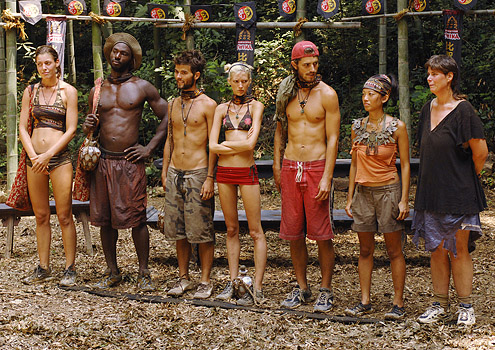
    Hanks' amiability is of course enhanced a hundredfold by his later isolation in an island in the middle of the Pacific Ocean. And it’s not just because we love to see people put in spots that weaken them but also because we kind of miss those spots in our lives. In present-day drabness amidst routine, the enjoyment of watching such movies as Cast Away are both a celebration of our good fortunes within our lives’ drabness as well as a vicarious adventure for our repressed-yuppie Survivor-ish desires to be put on the spot.


photo from http://www.lindsaybrothers.com/blog/survivor/survivor_thin/

    It’s the same double-edged and contradictory enjoyment that we get from action heroes in deadly self-assigned missions. It’s the same double-bladed knife that cuts our hearts while reading stories about heroes or anti-heroes who have gone through an oppressive treatment from a majority in a village, city, or country. It shouldn’t be a mystery therefore to find ourselves, every now and then, rooting for the underdog. Our rooting for a likely winner, in contrast, is often due to either our having perceived or witnessed or known some oppression upon this person’s person from somewhere in his story, otherwise to a tensive vulnerability through this likely winner’s limits-testing tragic vanity.
    Politicians have an all-too-conscious feel for this PR reality concerning the public’s attraction to the pained. So that when a most hated political opponent dies, they offer their possible presences or sympathies lest the suddenly-softened public steer away from the surviving politicians' hardened souls.
    Gossips also suddenly feel both triumphant and sympathetic and afraid when a subject of their hateful judgments begins to cry.
    Many women even possess a backhanded sexism towards their own/selves with the recurrent expression of pride in their being tagged "the weaker sex". For instance, in the Philippines, where women can freely wear mini skirts and can run for president, many Filipinas still believe that Real Men don’t fight with their wives but merely allow them to be the emotional and articulate ones. As if a woman’s outbursts are to be equated with a child’s tantrums, best left relatively unattended or reacted to not.
    That said, we can now perhaps conclude that humans are quasi-masochistic beings in the sense that they would have to imagine themselves pained in order to qualify for love solicitations. For they know that they, qua subjects to others' eyes, become truer persons in the tension of possible death or during cinematic moments of slow passing away into obsolescence in life.


THE REASON why we can easily fall for the gibber of actors in real life is because we’ve seen them play most vulnerable and oppressed characters in fiction or fictionalized cinema that have endeared them to us. To the public eye, too, artists and poets---once introduced as so---are often seen as likeable soft personae, despite the swagger or tough look that some of them might display. Rock stars became stars because they dramatized themselves as vulnerable gods forever on the brink of destruction.
    A national hero is a mere emblem of some political mythology that we generally can’t really relate to emotionally nor consign significance to as individuals, until we see a movie about the hero’s mistakes and demoralization. Then he becomes a true hero to us, almost a friend.
    This reaction doesn’t stop at our impressions upon others. It also extends to our regard for our respective selves. Although many find it hard to admit this truism, still it is not hard to remember that the moments where we have been most proud of ourselves were those wherein we faced a truth, admitted a mistake, or had to wear modesty (with a smile) like a torn suit.
    Races-wise, small Asians may prove themselves equal in political or military virility to superpowers’ braggadocio and bullying when they begin to feel comfortable about their difference to the Others, with their shorter penis or body height, thence taking strides forward in the aftermath of this humble acceptance. Its like the realization that not everybody has to be a tall power forward in a basketball team; one can be a great shooting guard shooting from outside and from underneath. The Japanese, prime examples of Shintoist-Buddhist courage within humility and selflessness, demonstrate/d this pride well, at one time even extending it to arrogance within a different kind of mythical and nationalist humility.
    In the case of the social oppression of the individual, he, the individual, usually begins to take strides in a process of freely moving on when he finally concedes to the impossibility of enlightening a majority that is always wrong (or always right for the wrong reasons), proceeding thence to take care of himself and cease and desist from trying to help a public that refuses to be helped.
    Stories of a weakened existence, of tension threatening annihilation, or of an Achilles heel that took a step towards love, . . . these are human signals that make heroes real, enemies friends, the earlier-despised Malèna in the year-2000 Italian film suddenly adored. Never mind if it’s sometimes too late an acknowledgment, because it couldn’t really be otherwise.
    Given all the above, it is perhaps safe to say that the ideal human being would be that one who sincerely acknowledges, or is forced to acknowledge, these human characteristics of constant vulnerability and weakness, acknowledging them even while struggling to control the self’s righteousness or even its recurring greed. Christians call this being reminded of a higher God even while pursuing Mammon.
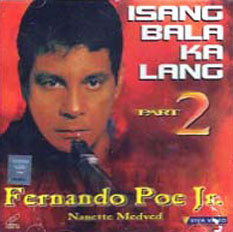
    Now, just today, Fernando Poe Jr. died. Before his demise he was declared, by his opponents of course, as a symbol of the Filipino supposedly good, however flawed, but all too willing to forgive all those who stood for greed, larceny, and hedonism, allowing himself be surrounded by these unrepentant male and female whores that comprised his disciples and puppeteers.


photo from http://www.nndb.com/people/278/000047137/

    The party of Gloria Macapagal-Arroyo did indeed voice out the thoughts of that above paragraph at their political sorties in recent history, in the heat of the last election's campaign and after, never mind if they were wont to put aside their own questionable dealings and shortcomings in governance and power.
    Macapagal-Arroyo, however, recognizes that today Poe will presently be the people’s good man, having been weakened by Death and been Christianized completely. So the former called him a good man, and so on and so forth, never mind her party’s likely guffaws at the thought of Poe’s wife Susan Roces’ being touted by the opposition as Poe’s possible successor.
    This recognition is understandable. After all, politicians also understand that in the eyes of God and humanity we are all Mr. Beans. We are all, both the generally evil and the generally good, sooner or later exposed as but fumbling characters in funny lives, amiable as learning tools and as reminders of ourselves. That inevitability is what will make us to others amiable instead of despicable, on earth as in heaven; that amiability will further be enhanced of course by the cynical atmosphere of a sane world of governance replete with godly ambitions, evil, corruption working us, influencing us. At least while Hobbes' truth remains, God should win at least a trillion best writer-director awards for creating such affable characters, however true the fact is that these characters have at one time or another been friendly to self-appointed gods, those enemies of the poor and oppressed humans, or otherwise been too saintly and iconic for popular appreciation. These characters can't be other than our friendly dolls, being our educational clones.
    When the day comes, even the godlike Gloria Arroyo will be an affable Mr. Bean cartoon character. Even if only for a day, as the day's Sesame Street-word of a TV special. [END]


photo from http://maspnational.files.wordpress.com/2009/07/gma.jpg


Wednesday, December 8, 2004

Colors and Politics Are Like Apples and Oranges


photo borrowed from http://www.flickr.com/photos/agrippinamaior/2684909840/


THE YOUNG MAN I hired to cut the bamboo in my yard is now painting my ceiling. The ceiling is going to be painted orange, the color presently making the rounds of restaurants and fastfood shops in the country, not to mention the streets of Ukraine in an ongoing so-called Orange Revolution. Orange seems also to have only recently become a popular color among makers of button-down-collared short-sleeved shirts (polo shirts) and their buyers. And although gays seemed to have wanted to claim the color in the mid-‘90s as yet another of their flag and sofa/couch colors beside the traditional lavender or the recurrent pink, heterosexuals in their turn seemed to have acted in defiance of the virtual appropriation, thus denying gays the privilege.
    Pink itself has recently been liberated from the gay fences by corporate taste, thanks perhaps to Japanese TQM gurus and their pinku waishatsus and to the members of golf clubs in the US of A sporting pink shirts, to pink films and the Pink Grand Prix, to Pinky ofPinky and the Brain , and to John Edwards' use of John Mellencamp's "Pink Houses" in his presidential campaigning. Pink used to be the official color assigned to socialists in the USA and South Africa---the pinkos , remember?---and was the flag color of Hitler's panzer divisions.
    Deep purple, meanwhile, used to be a hippie band waxing psychedelic rock, but it---the color---was later re-assigned for gay usage, if only for being near lavender. Latinos, however, would every now and then proudly parade the color as a symbol of their race qua masters of color boldness and handling, but more likely because it is a decidedly liturgical color as well as part of the anti-Catholic Second Spanish Republic's flag. It later became the color of feminists, but heterosexual males' interior design plans for their offices are also slowly reclaiming it, as if to reassert the color’s early associations with male royalty. Hippies used the color, too, to allude both to Jesus' royalty or simply for psychedelic completeness. . . . So, having said all the above, what’s obvious is this: the quirky use of colors is almost at the level of people wanting to copyright them, if only they could, and all for certain political statuses.
    Anyway, some of the bamboo I and the young man I hired had earlier cut . . . well, we used them for scaffolding. But I'm still a little embarrassed with the cutting, being in this year and month when the Philippines once again figured in CNN's top three headlines with the news about the flash floods in Quezon province, the Bicol Region, and the Central Luzon area, which killed as many as 400+ Filipinos as of last accounting. A total logging ban was enforced, and I suppose bamboo shouldn’t be exempt if located on hills overlooking towns or otherwise inside flood-prone districts of a city or municipality.
    But in my neighborhood there might be that no-need-to-ask demand for the bamboo to be cut to help, please, the corrugated galvanized iron sheet roofing lengthen its life and likewise save on energy drink required for the daily sweeping of fallen bamboo leaves on my and my neighbor’s lawns. So, the bamboo had to go and found new function.
    The new function was as scaffolding, as we mentioned, initially for some decorative or psychological purpose, the painting of an orange ceiling.


ALL DECORATIVE things are psychological items, the reason why I've always put a premium on decorators in my lifetime, no lower a valuation than my regard for the great men of science and the philosopher-kings. But there are good decorators and bad decorators, or there are good decorations that are not good for you and so therefore do not serve their psychological purpose, unless their purpose is for psychological warfare, decidedly with the intent of hurting someone's eyes and make him want to go to sleep.
    So, back to my orange ceiling. Yellow-orange, to be precise. What are the politics around it, accompanying the politics of the bamboo used for scaffolding? Well, there is the quasi-science around it, the psychology of the décor. Orange makes you feel warm, a function handy in a city-subdivision that receives constant winds from the Pacific in the east bouncing off the recurrently damp hills in the west with their bamboo and coconut vegetation. One cannot anymore be suspected of being gay with an orange ceiling, unlike five years back when a Boy Abunda would visit the ad agency I worked for and exclaim "this orange sofa of yours is just so . . . gay. Only somebody like that can think of a color like this." Maybe because it was a more pinkish kind of orange, and at least one of our influential bosses was openly gay. No, especially with the proliferation of restaurants and doughnut or burger shops boasting of its supposedly appetite-enhancing function, orange is now for everybody and anybody. Recently also, as we mentioned above, the Ukrainian opposition carried the orange color as its symbol, and CNN averred this was probably intended to avert possible violence in the restless country, for reasons unknown to me. Anyway, orange has chiefly been associated with social democrat, Christian democrat and populist parties, whether liberal conservative- or conservative liberal-leaning. But we can't limit it to that, since in Northern Ireland it's been associated with unionism, while in the Netherlands it's the color of the monarchist right wing. Anyway, there is orange and there’s orange. The saffron kind is usually associated with pain and Hinduism. But put that same color in a Dunkin' Donuts shop and you’d get an entirely different context, more gustatory than yogi-tory. Put the same Dunkin’ Donuts scheme in an Indian shop and it’s another thing again.
    What does all this say? If color can be an indication of a person’s or building’s personality or mood, the opposite is also true---it cannot categorically say anything. The statements of certain persons and establishments can actually re-contextualize a color. If, for example, a neo-Nazi group were to be born somewhere, their displaying an orange flag with a black and white swastika circle in the middle would certainly displace the warmth of orange, as it would the Hinduist sacrifice context the color offers. It will become the new color of disguised or explicit hatred.
    Therefore, I could list down all the values the color orange will reflect into my living room and dining room and bedroom from the ceiling. But what I do in this, my parents' deserted Tacloban house, in the coming days when glossy yellow-orange remains my ceiling's color, will carry all the political and cultural shades of that color to several possibilities. Should I, one night, start throwing plates, hurry out of my orange house challenging my neighbors to some bolo knife-play, the color orange will certainly be stamped in my neighbors’ memories as that color once seen running amok in the city-subdivision. I could be tagged with a new nickname, Datu Oring the Bolo King, or something like that, even if my inspiration for the color was merely the sunset color from the hill in the west that would hit my white kitchen wall from 4pm onwards. I had that wall painted orange and green, too, to sort of meet the sunset orange and mimic the orange and green of the papayas on my kitchen dining table.


I MOST noticed and felt this flexibility in colors, swinging from banal amiability to social assertiveness, in corporate Manila. Manila offices have increasingly become more experimental with coloration. Undoubtedly, office designers of chicness have transformed some of today's offices into friendlier spaces.
    But, again, it all depends. Unsmiling faces manning the receptionist's or customer service desks could turn the whole atmospheric amiability of colors into a sort of fearsome plastic Trojan horse that, from your offended point of view, could suddenly look contrived, merely in it to get your approval. You'd then step back and withdraw your application or customership.
    A beautiful office with probably the best feng shui design may suddenly expose labor restlessness, quickly converting the friendly-colored establishment into a political arena containing mental gladiators and lions and possible blood vampires. Conversely, the worst-dressed lady executive despised by all for wearing that cheap perfume of hers on her horrifying violet and flowers-patterned office dress may actually suddenly turn out to be the champion of a corporation's workforce and become the union's heroine, her abominable coloration there instantly turning adorable.
    There are colors, on objects, that carry "intrinsic" psychological or cultural values. Such as those universal carriers of color-moods as fruits---for instance, the papayas we mentioned. However, there are also mental colors in gestures and body and facial language and in speech that will synaesthetically blend with the visual colors of the physical surround of any establishment during these human-derived movements' moments of special assertions. And that combination will be noticed, consciously or subconsciously, for a logical conclusion---much like how premises function for logic. Thus, perfect black worn by yuppies in coffeeshops makes for a different mood and signification against the fading black worn by those rock music fans who can’t afford P30 beers. Beyond black's classiness as well as silent dissent, that difference transcends the color's umbrella meaning, or rather divides it. The black of corporate people are usually new black, while punk and grunge rockers and underpaid artists may favor---for obvious reasons---the fading kind of lamp black that’s almost just soot. But yet, notice that when the yuppie wears the faded black color and the rogue rocker wears the perfect black one, neither the yuppie's yuppieness nor the rocker's rogueness changes, in the same way that a rich kid studying at Ateneo de Manila University won't exactly get his image changed by a pair of jeans ripped at a knee.
    Let us place ourselves in a fine arts college. A student who is often seen in light gray shirts could be regarded as a drab young person. After a certain college recognition of his prolificacy and creativity, however, the gray becomes a symbol of a modesty and moderation blanketing a flamboyance in his inner person. Most successful painters, after all, avoid colorful clothing in the same way that models pick up their blue jeans and white t-shirts after a glamorous ramp show.
    Ultimately, therefore, in the same sense that the BAD feng shui of an owner's soul may overshadow the GOOD feng shui of his building and office, a nicely-painted house may anytime be overwhelmed by a horrifying behavior from its inhabitants.
    Colors and you. The you will be the achievement, the colors the mere psychological facade. The colors you choose, with their politics and psychological effect, could speak of a truth about you, but also possibly a lie.
    I suggest we save money for the re-coloring of our houses and lives as our lives move forward, all in the service of truth---it is this truth, after all, that can in a blink of an eye re-contextualize the politics around a color.
    But I grant that a welcoming color is apt for guest-welcoming in a house. But, then, many offices (and some restaurants) also operate on lies! So, be careful with the contextual predetermination of your domestic use of oranges and apple greens. For, remember, that warning has proved true for the past's use of political colors. ###


Wednesday, November 3, 2004

Art as Politics; Politics as Art


WATCHING SAMURAI X or a similar anime series on TV the other day, I noticed a certain resemblance to the Peter Jackson-helmed The Lord of the Rings trilogy effect---effect on me, at least, as a passer-by viewer. So, you can just imagine its effect on the anime fan! The effect I'm talking about is anime's potential propagandistic charisma value that the Japanese probably are aware of. Now, I am not so much talking about the content, which may vary from anime to anime (albeit a constant pattern may be gleaned by any curious social scientism). I’m more inclined to talk about and celebrate the virtue of fantasy in the hands of The Good, wherein some Hitlerian (or Hirohito-ish) grandiosity must be restrained from temptations that might allow it to express either some inner Big Hate or some Gargantuan Intellectual Philosophy of Greed. Because, believe me, this charisma value can be quite charming.
    Anime cartoons are fantasy cartoons in more ways than one. They neither pretend to be realistic comedy cartoons nor do they kowtow to the category of children’s programming. Anime is considered an art in itself, involving a fantastic plot and a fantastic power object portrayed via another Japanese fantastic achievement: the anime eyes.
    Now, anime eyes are a Japanese vehicle for escape from the global stereotype on Orientals as squinty-eyed, but its design goes further than the Western man’s larger eyes to produce in the end a different nation that’s ultimately quasi-Japanese and quasi-Western, the citizens of which Different Nation inhabit a globally-marketable art. Add to this, anime characters’ hair color try to eschew ground level by exploring the possibilities of dis-blacking. This style propagated a trend in Japan of color-dyed hair among the youth (and later the middle-aged) previously only plausible in the urban planet among so-called fashion punks.
    Much has been said by many a lay philosopher today about the escapism of fantasy literature and art vis a vis the boldness of realism and allusive expressionist passion. The Lord of the Rings trilogy of the Lord Dunsany school of literature which was delivered through the genius of J.R.R. Tolkien have influenced fantasy lovers way before the book's story was made into three special-effects breakthroughs, as had the pioneering progressive rock of Yes and King Crimson and Uriah Heep and the psychedelic blues-rock of Led Zeppelin, as have later oeuvres of high-tech special effects such as the George Lucas-written and -megged fantasy classic Star Wars. However, in the liberal press today, fantasy art is given credence as serious art only when driven by artists and authors surrounded by a traffic of political oppression (within a geo-political or ethnic boundary); these artists’ works supposedly hide or enhance a political satire or symbological value. When flaunted by artists in happy surrounds, however, fantasy art is often deemed by the liberal or even conservative snobbish critic as simple fantasy devoid of any socially-redeeming significance as art.
    In the age of post-structuralism and Marxist criticism, however, reviewers have been given easy license to read (or over-read) almost anything into anything, thus the term cultural studies, the only universal rule being that the reading maintains integrity within the construct. This certainly went further than Marcel Duchamp's now-lame proposal that anything exhibited in a gallery may qualify itself as art. (Certain thinkers decry integrity in reading, meanwhile, celebrating entropy and disavowing criticisms against "unintelligent" readings by the masses.) So Star Wars can now be taken into a classroom and deconstructed to fit any personal or political agenda into the work, and that is not anymore considered shameful. Indeed, we can say that in our age artworks are liberated from the author-dictated (or New Critics-proposed) moral, and are now surrendered to the intelligence or lack thereof of the masses or the masses’ favorite authority critic (who may then offer various readings or approaches to the consumer masses), thus, finally, dis-glamorizing snobbery. So why, we ask, does fantasy art still manufacture frowns from authorities at Cannes or Stockholm? Perhaps because post-structuralism, supposedly masses-friendly but ridden with academic gibberish of a new snobbishness, didn’t exactly create a trickle-down effect upon magazine reviewers. In the end, it's as if post-structuralism has yet to happen and history continues to flow on unhindered as a manifestation of the law of God consisting of repetitions and second comings devoid of academic views and lessons. Devoid, that is, of both the fantasy of a hermeneutics from a campus distance or the social hermeneutics delivered through a distantly fantastic construct aided by alcohol or drugs or the naturally imaginative individual.
    There will always be the divide between realists and expressionists, but the divide between these readily-popular alluders and their fantasy art counterparts are wider still. And this will remain an interesting kind of divide, with the former not confronting the latter but ignoring the seriousness of their lot, never mind that this lot comprises the higher percentage of the mythology of the populace.
    Realists will, however, not begrudge fantasy artists their "rightful" place in society. Today's anime cartoons, along with fantastic movies like The Lord of the Rings, not only create entertainment offering momentary escape from our dirty laundry and the depressing art films from the festivals and the subtle artistry from Congress' halls, they also inspire creativity with measure. Such measure is easy where the art (with its accompanying creativity) is almost an end in itself. As in clothes fashion. L'art pour l'art. Many fine cinema techniques can be traced to comics art, in the way technology traces its achievements to basic science. Were anime not fantasy, I doubt that it would come up with the visual quirks (lighting, color, lines, etc.) that are in the level of what theatre people and fashion ramp aficionados proudly refer to as meaningless creative faggotry beloved of Broadway.
    But what do we make of it when certain fantasy artists, beyond the academicized critics, proclaim on their own their arts’ realist side, that is, their social significance beyond the merely entertaining or l’art pour l’art (read: decorative) value? Do we take them seriously? Have we really taken science fiction seriously beyond the claims of the college curriculum, at this same podium where we’ve regarded magic realism with awe?
    Perhaps the answer is that fantasy is simply too much of an achievement of metaphors. The "real world" already abounds in perceivable metaphors . . . so, why create another mythological world? And, conversely or accordingly, everything is fantasy anyway. A paragraph that describes a coffee break in a Milan sidewalk café might read as fantasy to a University of the Philippines Diliman student from the province who saves up on his allowance to be able to sip at Starbucks on his weekend.
    As for realism, I wonder how realist it really is. An early literary movement called Naturalism claimed more real realism in the portrayal of the helplessness of the individual as victim of his surround, beyond salvage by the fantasies of revolutionists. And although this genre (as in the talents of a Eugene O'Neill or Alexander Solzhenitsyn) clamored for a kind of counter-revolution (Solzhenitsyn against a continuing communist "morality," for example), the Naturalist’s art itself had to portray a reality first; not the reality of omniscient organizers of reality but the reality of the imprisoned denied vision of anything beyond the four walls of his cell (and inner cell). Therefore, to the Naturalist, so-called Realism is fantasy. Ernest Hemingway’s own type of quasi-inner naturalism already regarded realists as suspect.
    But fantasy art's role, like anime, will continue to be equated with the functions of background music, chandeliers, relaxant drugs, tapestries, or postcards. Entertaining tools, mere artisans’ produce. Which does not exactly sound demeaning or insulting, but yet decidedly relegated to a lower echelon in the kingdom of criticism.
    Perhaps this is all cultural. The miracles in the Bible are not viewed by Christians as fantastic but rather as historical (or quasi-historical). And as for being a matter of degree, with realist art having more reality in it than fantasy, fantasy having less, this theory likewise turns suspect when we start to consider the claims of science fiction or fantasy literature authors that humanity exists purportedly not in the world of the "real" but in the inner landscape we carry with us everyday. This inner landscape could actually be in any setting at all, they'd say. So, a Milan café is no more real than a cave in Mars. And wherever fiction is located, the same real human principles apply, as it did among the power-brokering and struggles developing in The Lord of the Rings or Spiderman or Winnie the Pooh. As it does in the amazing cartoons of anime art. They might claim that an utter removal from readily-allusive reality creates that distance that allows humanity to focus on the principles by themselves, not on some trivial facts of everyday politics.
     For, sure, imaginativeness or creativity is probably exercised fully in fantasy literature and art (being armed with a freedom like those on the shoulders of basic-science researchers, unless pressured by a direct corporate or market demand). But one’s understanding of human behaviour is also exercised here. Wouldn't present human behaviour be better exposed in a sci-fi novel? These same exercises among fantasy authors and artists are also operational in fantasy readers and viewers. After all, when we come right down to basics, seeing the category "Fiction" in a magazine automatically relegates pieces in this zone to the level of fantasy vis a vis the claimed realism or objectivity of the news, and the reader accepts this fantasy, suspending disbelief in his submission. It’s time we admit that all art is nothing but fantasy, and that therefore our first obligation as artists is to art itself, avoiding being boring or un-fresh, especially when ready realist allusions realistically point to boring trivia about figures in current history, veering away from the distance of the mythologizing process of art.


THE RECENTLY-concluded US elections were full of fantasy and realism. A lot of real facts about George W. Bush’s and friends’ businesses in the Middle East were touted by his camp’s defenders as mere lies, and a collection of political measures and war-machine restraint in contender John Kerry as unrealistic. Meanwhile, some of us in the social liberal side of the globe were amazed at the restraint that Kerry displayed in avoiding mention of such red meat potentials against G.W. Bush as United Defence or Unocal, which Green Party candidate Ralph Nader (armed with the l'art pour l'art freedom to spill the most conservative-offending beans) would have no qualms mentioning and offering to the media head-on. Which filmmaker Michael Moore, as critic of both Republican and Democrat meta-narratives, had no reservations in exposing. Which Fox News, for all its denials of being a Republican propaganda bus stop, made open efforts to deny.
    Fantasy and realist portrayals are two approaches to the same thing---Art, which draws the myths and illusions of every profession and its accompanying uniform, of every business enterprise with its marketing, of every political career with its restraints and compromises, of every greed with its blueprint scheme and impending grand architecture, of every religious mission, and---finally---of every nation’s delusion, escapism, or self-imaging designs.
    But the only truly realist portrait is an inner one, because it draws the mythological and propagandistic face of a winner. This winning, however, is made possible by the art and lie of the imagination, combined with a restraint towards realist allusion. It is what makes all fantastic realities succeed. They succeed by virtue of an acceptance of their own mythology, which acceptance gives them the moral license to bare others' myths.